
Nine Killed in New Market Hotel Fire
A devastating hotel fire in Kolkata’s New Market area has once again exposed serious questions about fire safety, building regulations, and administrative oversight in the city.
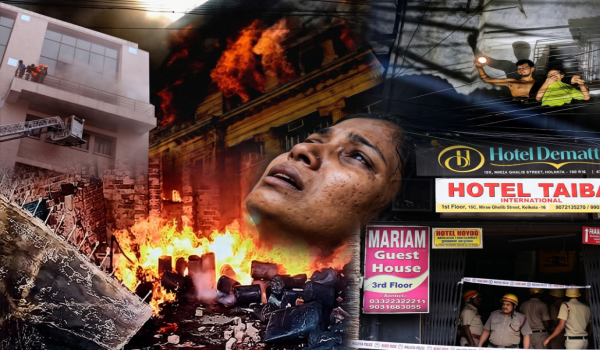
The blaze broke out at the Shikha Inn on Mirza Ghalib Street between 1:30am and 2am on Tuesday. Nine people died in the incident, most of them reportedly from suffocation after thick smoke spread rapidly through the building.
The tragedy came only around 45 hours after another deadly hotel fire at Tarapith claimed nine lives. Together, the two incidents left 18 people dead within less than two days.
The latest disaster has triggered a fresh political battle over who should be held responsible. But beyond the accusations, the incident has raised a more troubling question: why are dangerous buildings allowed to operate until people die?
A Hotel Hidden Inside a Crowded Building
Shikha Inn was located on the third floor of a four-story building covering roughly 1,100 square feet. The property reportedly housed several hotels and guesthouses under the same roof.
The hotel itself had only five small rooms. Although some rooms had air-conditioning and attached bathrooms, the overall structure was extremely cramped.
The building had a narrow staircase and a single, relatively small entrance and exit. Such arrangements can become deadly during a fire, particularly when smoke spreads faster than people can escape.
The New Market and surrounding areas are filled with similar budget hotels and guest houses. Many are used by patients and relatives who travel to Kolkata for medical treatment. A significant number of visitors come from Bangladesh.
Among those killed in the Shikha Inn fire were at least five Bangladeshi nationals.
Ten people were reportedly staying at the hotel when the fire started. Eight guests and one hotel employee died.
Bangladeshi Family Among the Victims
Journalist Debashish Dutta, who worked for the Bangladeshi newspaper Ajker Patrika, was among those killed. He had traveled from Kushtia with his wife, young son, and father-in-law for medical treatment.
None of the four survived the fire.
Another victim was reportedly a Dhaka resident. Nineteen-year-old Sandeep Paswan, who had traveled from Jharkhand and had been working at the hotel for around three months, was found dead near the reception area.
Sixty-eight-year-old Jognarayan Agarwal had traveled from Siliguri.
Two other victims remained unidentified at the time of the initial reports.
Most of the victims appear to have died after being trapped by smoke rather than directly by flames.
Survivors Described a Terrifying Escape
The people who survived described scenes of panic and confusion.
One couple reportedly broke a window and stood on the building’s exterior ledge to escape the smoke.
Two friends who had arrived from Rampurhat and were staying at a guest house on the fourth floor also described their ordeal.
They had gone to sleep after eating late at night. Around 2:15am, they were awakened by the screams of two women.
When they opened their door, smoke had already filled the room.
The narrow corridor outside had also disappeared behind a wall of smoke, making it difficult to identify an escape route.
Another resident said the smoke became so thick that breathing was extremely difficult. The arrival of firefighters ultimately helped save those who remained trapped inside.
The accounts highlight how quickly a fire can become fatal when a building has narrow access routes and inadequate emergency systems.
Why Was Such a Building Allowed to Operate?
The hotel’s location has intensified public concern.
Shikha Inn was reportedly only about a kilometer from the Kolkata Municipal Corporation’s headquarters. The New Market police station was even closer, while the fire department’s headquarters was just one building away.
Fire officials regularly travel through the area.
That has led to a simple but uncomfortable question: how did a building containing multiple small hotels and guesthouses continue to operate despite its cramped layout and apparent safety problems?
According to allegations raised after the fire, the building may originally have been intended for residential use and later converted for commercial purposes.
Such a conversion normally requires official approval. Depending on the nature of the business and the building, permissions may involve the municipal corporation, trade licensing authorities, the fire department, and other regulatory bodies.
Authorities are now facing questions over whether the necessary approvals and inspections were properly completed.
Political Blame Begins After the Fire
As is often the case after a major disaster, political accusations quickly followed.
Fire department officials blamed problems inherited from the previous administration and questioned how trade licenses and permissions could have been granted.
State leaders also questioned whether proper fire safety approvals were in place and whether electrical authorities had followed the required procedures.
Former municipal officials, meanwhile, rejected the suggestion that political leaders could personally monitor every trade license issued by the corporation.
The political exchange has created a familiar pattern: one side points to the previous government, while the other points toward the agencies responsible for inspections and enforcement.
But for families who lost loved ones, political arguments offer little comfort.
The central issue remains whether authorities failed to identify obvious safety risks before the tragedy occurred.
Fire Safety Problems Found Across the Area
The Shikha Inn building was not reportedly an isolated case.
A visit to nearby streets, including Marquis Street, Rafi Ahmed Kidwai Road, Ripon Street, and Sadar Street, reportedly revealed several crowded hotels with questionable fire safety arrangements.
In some properties, sprinklers were present, but proper hose systems were missing. In others, pipes existed without a reliable water connection.
Investigators also reportedly found malfunctioning fire alarms and locked pump rooms.
These findings suggest that the problem may extend far beyond one hotel.
A dangerous building becomes even more hazardous when safety equipment exists only on paper but cannot actually be used during an emergency.
How the Fire Spread So Quickly
Preliminary forensic observations indicated that the fire may have started in the reception area, possibly due to a short circuit.
The reception was only a few feet wide and contained furniture, a television, and other combustible items.
Another major concern was the building’s interior construction.
The rooms were separated by walls that did not extend fully from floor to ceiling. Instead, wooden false ceilings connected the spaces.
This design potentially allowed smoke to move rapidly from one room to another.
Some rooms were so small that conventional doors were difficult to install, leading to the use of sliding doors.
As the smoke traveled through the false ceiling and confined spaces, people in the rooms had little time to react.
The bodies of victims were reportedly discovered in different parts of the rooms, including on beds, floors, and inside bathrooms.
Forensic officials collected burnt wires, television components and other samples as part of the investigation.
Kolkata’s Wider Fire Safety Crisis
The incident has also drawn attention to the broader shortage of firefighting infrastructure in West Bengal.
A Comptroller and Auditor General report cited figures showing that hundreds of people had died in fires across the state in a single year.
There is also a major gap between the number of fire stations considered necessary and the number actually available.
According to figures cited in the report, West Bengal required hundreds more fire stations than it had at the time, resulting in a significant infrastructure shortfall.
A lack of personnel has added another challenge.
In a densely populated city such as Kolkata, where old buildings, narrow lanes, and crowded commercial areas often coexist, fire response capacity is especially important.
Inspections Ordered After the Tragedy
Following the New Market hotel fire, authorities canceled the affected property’s trade license and announced plans for inspection audits across the municipal area.
Officials were instructed to submit reports identifying irregularities.
The administration has also promised stricter enforcement and action against buildings that fail to meet safety requirements.
But similar promises have been made after previous disasters.
That is why the biggest challenge now is not simply identifying violations. It ensures that inspections actually happen before the next fire.
The Question Kolkata Cannot Ignore
The New Market tragedy has once again exposed a painful cycle.
A fire breaks out. People die. Authorities discover illegal construction, missing equipment, or failed inspections. Political leaders trade accusations. New inspections are announced. Then, public attention gradually moves elsewhere.
Until another tragedy happens.
The deaths at Shikha Inn should not become another entry in that cycle.
The most important lesson is straightforward: fire safety rules are not paperwork. In a crowded hotel, a narrow staircase, a locked pump room, or a missing alarm can mean the difference between survival and death.
The responsibility lies not only with hotel owners and building operators but also with the agencies that approve, inspect, and enforce safety standards.
The real test for Kolkata’s administration will come in the weeks and months ahead.
If unsafe hotels are identified and genuinely shut down or brought up to standard, the New Market tragedy could lead to meaningful change.
If inspections once again produce reports without lasting action, the city may simply be waiting for the next disaster.