


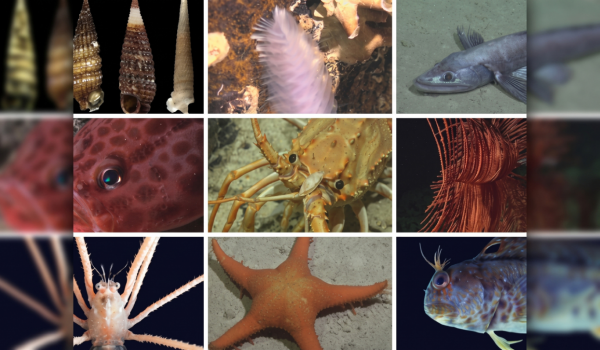
The deep ocean has once again shown just how little we know about life on our own planet. During a year-long series of marine expeditions, scientists documented 1,121 previously unknown marine species, including several creatures so strange-looking that they could easily be mistaken for life from another world.
Some were discovered hundreds or thousands of meters beneath the ocean surface, where sunlight barely reaches. Others came from much shallower waters in Southeast Asia. Together, these discoveries offer a remarkable glimpse into a hidden underwater world that remains largely unexplored.
Strange Creatures Hidden Beneath the Waves
Imagine descending into the dark ocean and finding an animal with an unusual body and face that looks almost impossible to recognize as an Earth creature.
Elsewhere, researchers found a tiny, brightly coloured worm measuring less than three centimeters long. Its vivid appearance may serve as a warning to predators, making the tiny animal look more like something from a science-fiction movie than a real creature.
But these animals are not fictional aliens.
They are part of Earth’s extraordinary marine ecosystem.
And scientists are discovering that there may be far more of them than previously known.
1,121 New Marine Species Identified in One Year
The discoveries were made through the work of Ocean Census, an international scientific initiative focused on finding and documenting marine life that has not yet been formally recognized by science.
Between April 1, 2025, and March 31, 2026, researchers carried out 13 expeditions and nine specialized species-discovery workshops as part of Ocean Census’s third year of activity.
During that period, scientists recorded 1,121 species previously unknown to science.
The number is particularly striking because these discoveries came from a relatively short period of research. According to Ocean Census, the annual rate of marine species identification increased by approximately 54 percent compared with the previous period.
That means researchers are not simply finding a few unusual animals here and there. They are uncovering large numbers of potentially new forms of life at a remarkable pace.
From Shallow Waters to the Deep Sea
The expeditions explored marine environments with dramatically different conditions.
Some specimens were collected in relatively shallow coastal waters, while others were collected at depths of approximately 6,575 meters.
At those depths, the environment is almost completely dark. Pressure becomes enormous, temperatures can be extremely low, and food is often scarce.
Yet life continues to thrive.
Scientists documented a wide range of marine organisms during the expeditions, including corals, crabs, shrimp, sea urchins, and anemones.
The variety highlights an important fact about Earth’s oceans: the deeper scientists look, the more biological diversity they can find.
A Tiny Worm With a Remarkable Appearance
One of the more unusual discoveries came from shallow waters in Southeast Asia.
The colorful worm is less than three centimeters long, but its bright body immediately attracts attention. Scientists believe its vivid coloring could potentially function as a warning signal to predators.
In nature, bright colors sometimes tell other animals that a creature may be dangerous, poisonous, or simply not worth attacking.
For such a tiny animal, the appearance can therefore play an important role in survival.
The discovery also demonstrates that scientists do not need to travel to the deepest parts of the ocean to find something completely new. Unknown species can still be hiding relatively close to coastlines.
An Underwater World That Looks Like Another Planet
The strange appearance of many deep-sea organisms has long fascinated scientists.
Some have enormous mouths, unusual shapes, transparent bodies, glowing organs, or bizarre methods of movement. Others have adapted to extreme environments in ways that are difficult to imagine from a human perspective.
That is why newly discovered marine species can sometimes look almost extraterrestrial.
The irony is that humans have invested enormous resources in exploring the Moon and sending spacecraft and robots toward Mars, while large parts of Earth’s own oceans remain poorly understood.
Scientists can photograph distant planets, but countless creatures on our planet have never been scientifically described.
Why Scientists Still Know So Little About Ocean Life
The ocean covers roughly 71 percent of Earth’s surface, but much of it remains difficult and expensive to explore.
Deep-sea research requires specialized ships, remotely operated vehicles, submersibles, advanced cameras, and highly trained scientists.
Even when researchers collect an unfamiliar specimen, identifying it can take considerable time.
Scientists must compare its physical characteristics with known species, examine its anatomy, and sometimes analyze genetic information. In many cases, experts also need to determine whether the organism represents a genuinely new species or simply a previously known species that looks different.
This makes the discovery of 1,121 previously unknown species particularly significant.
It represents not just a collection of unusual animals, but a major scientific effort to expand humanity’s understanding of marine biodiversity.
Ocean Census Is Building a Map of Hidden Marine Life
The goal of Ocean Census goes beyond simply finding strange-looking animals.
The initiative is working to accelerate the discovery and identification of marine species worldwide. By documenting these organisms, researchers can build a clearer picture of how life is distributed throughout the oceans.
This information could become increasingly important as marine environments face growing pressure from climate change, pollution, overfishing, and other human activities.
Scientists cannot properly protect species they do not know exist.
Every newly identified organism, therefore, adds another piece to our understanding of the ocean ecosystem.
Discoveries From Thousands of Meters Below the Surface
The depth range explored during the recent research is especially impressive.
Specimens were found from shallow coastal areas all the way down to approximately 6,575 meters below the surface.
The deep ocean is one of the least accessible environments on Earth. At several kilometers beneath the waves, sunlight disappears completely, pressure becomes extreme, and the surrounding environment can be radically different from conditions at the surface.
Yet these discoveries show that the deep sea is far from lifeless.
Instead, it contains complex communities of organisms that have adapted to conditions humans could not survive without advanced equipment.
The Search for Aliens Starts at Home
Scientists are still searching for evidence of life beyond Earth. Mars remains one of the most closely studied planets in the Solar System, while researchers continue to investigate whether the moons of Jupiter and Saturn might have environments capable of supporting life.
But Earth’s oceans provide a fascinating reminder that life can be stranger than we expect, even without leaving our planet.
The discovery of 1,121 previously unknown marine species shows how much remains hidden beneath the waves.
Some of these organisms may eventually become important subjects of biological research. Others may simply add another fascinating branch to the tree of life.
What matters is that they were there all along.
Earth’s Oceans Still Hold Huge Secrets
Humanity has explored only a fraction of the world’s oceans in detail.
Every expedition has the potential to reveal creatures that scientists have never seen before. The latest Ocean Census discoveries are another powerful example of that reality.
From tiny colorful worms in Southeast Asian waters to organisms living more than six kilometers below the ocean surface, these animals demonstrate the incredible diversity of life on Earth.
So while scientists continue to search Mars and other worlds for signs of life, there is still an enormous unexplored universe beneath the waves.
We may not need to travel to another planet to find something that looks alien.
Sometimes, we only need to look deeper into our own ocean.