


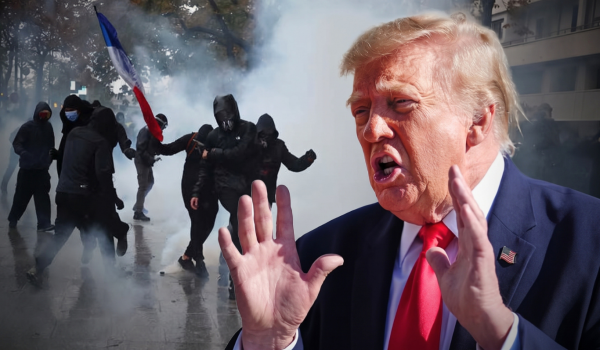
US President Donald Trump has linked France’s recent unrest to immigration, arguing that the country’s approach to border control has contributed to growing tensions. Speaking during a campaign visit to Georgia, Trump dismissed suggestions that problems within the education system were responsible for the demonstrations and instead blamed what he described as France’s willingness to open its borders to people who oppose the country.
His comments have brought immigration back into the political spotlight as Trump campaigns ahead of the US midterm elections. They also reflect his continued push for stricter immigration policies, both in the United States and beyond.
However, the unrest in France has been associated with several domestic concerns, including pressure on public services, rising living costs, and dissatisfaction with government policies. Trump’s comments have added an international political dimension to an already complicated situation.
Trump Says France Is Paying the Price for Its Immigration Policies
During his appearance in Georgia on Saturday, Trump offered a forceful assessment of the situation in France. He argued that the country’s authorities had failed to maintain effective control and suggested that the police were unable to respond adequately to the unrest.
“France has police, but they cannot do their job. That is why France is now burning,” Trump said, according to the remarks reported in the original account.
He also criticised France’s approach to immigration, claiming that the country had opened its borders even to people who allegedly hold hostile views towards it.
Trump argued that those participating in the unrest hate France and its people. His remarks presented immigration as a central factor behind the country’s difficulties, although the available account does not establish that the demonstrators’ views or immigration status support that generalisation.
The US president has repeatedly used immigration as a major political issue. His latest comments suggest that he intends to continue presenting border security as an essential part of maintaining national stability.
Trump Connects France’s Unrest to His Tough Immigration Agenda
Since returning to the White House for a second term, Trump has adopted a tougher approach to immigration and visa enforcement. His administration has pursued measures to restrict entry, review visa status, and increase pressure on people who do not meet US immigration requirements.
The administration has also argued that immigration affects employment opportunities, public resources, and economic security for American citizens. Trump has frequently presented stricter border controls as a way to protect American workers and preserve national interests.
During his Georgia speech, he applied similar arguments to France. He suggested that allowing large numbers of immigrants into a country without adequate restrictions could contribute to wider social and political problems.
Trump’s position reflects his broader political message: governments should exercise stronger control over who enters their countries and should prioritise the security and interests of their own citizens.
However, immigration is only one possible factor in debates about social tensions. Establishing whether it has contributed to a particular protest or outbreak of violence requires evidence about the specific events, participants, and underlying causes.
Trump Targets Democratic Senator Jon Ossoff Over Immigration
Trump also used the situation in France to criticise Democratic Senator Jon Ossoff of Georgia.
The president accused Ossoff of supporting policies that would allow large numbers of immigrants from developing countries to enter the United States. Trump described these prospective migrants as anti-American and argued that their arrival could threaten the country’s existing social and political order.
“What should we do with people like this? They should never be allowed into the country in the first place,” Trump said, referring to his position on immigration.
He went on to criticise Ossoff’s approach, claiming that the senator wanted to provide refuge to millions of immigrants who were hostile to American values.
Trump’s comments formed part of his wider effort to portray Democratic immigration policies as a threat to national security and American society. By drawing comparisons with France, he sought to reinforce his argument that stricter immigration controls are necessary.
The remarks also highlight how immigration is likely to remain a major point of disagreement between Republicans and Democrats as political campaigning continues.
Republicans have generally emphasised border enforcement and restrictions on unlawful immigration, while Democrats have supported a range of approaches that include border security alongside legal immigration pathways and protections for eligible migrants.
The details of individual proposals vary, making it important to distinguish political accusations from the actual policies being debated.
What Is Behind the Unrest in France?
Although Trump focused on immigration, the reported unrest in France has also been linked to domestic concerns, including problems affecting schools and public services.
Issues such as inadequate infrastructure, staff shortages, and pressure on public institutions have contributed to public dissatisfaction in the aftermath of the demonstrations. What began with concerns involving students reportedly grew into a broader movement as more people took to the streets to express frustration with the government.
The rising cost of living has also become a major source of concern for households in France. When everyday expenses increase faster than people’s ability to afford them, families can struggle to pay for housing, food, transport, and other basic needs.
At the same time, dissatisfaction with the quality and availability of public services can deepen frustration. Schools, healthcare facilities, and other public institutions play an important role in everyday life, and people may demand government action when they believe these services are failing to meet their needs.
These concerns provide a different perspective on the demonstrations from the one offered by Trump.
Rather than attributing the unrest primarily to immigration, understanding the situation requires examining the specific grievances raised by protesters, the government decisions they oppose, and the circumstances surrounding the incidents.
It is also important to distinguish peaceful demonstrations from criminal acts committed during periods of unrest. Participation in a protest does not automatically mean that an individual has taken part in violence or property damage.
Violence and Clashes Add to France’s Challenges
The demonstrations have reportedly escalated in some locations, with incidents involving clashes between protesters and police, looting, and fires affecting public property.
Major French cities, including Paris, Marseille, and Lyon, have been mentioned in reports about the unrest. The incidents have raised concerns about public safety, infrastructure damage, and the authorities’ ability to restore order.
Police have reportedly taken measures to contain the situation, including imposing curfews in affected areas and detaining demonstrators. However, these actions have not necessarily brought an immediate end to the tensions.
When protests turn violent, authorities face the difficult task of protecting residents, preventing further damage, and allowing lawful demonstrations to take place. The response can become a source of further controversy if protesters or other members of the public believe that police measures are excessive or ineffective.
The scale and causes of unrest can also differ from one city to another. For that reason, incidents in individual locations should not automatically be treated as evidence that every demonstrator shares the same motives.
The situation described in the original report reflects a combination of public dissatisfaction and incidents of disorder. A clearer assessment would require verified information about the timing, location, and causes of each event.
France Becomes a Political Example in America’s Immigration Debate
Trump’s comments demonstrate how events in other countries can become part of domestic political campaigns in the United States.
By pointing to France, the president sought to strengthen his argument that governments should maintain tighter control over immigration. His remarks also offered a direct attack on Democratic politicians who favour different immigration policies.
The comparison allows Trump to connect concerns about public safety and social stability with his central campaign message on border enforcement. It also gives his supporters an international example to consider when evaluating immigration policy.
However, the comparison should be treated as a political argument rather than a definitive explanation of the unrest in France. Demonstrations can emerge from several overlapping causes, and claims about immigration need to be supported by evidence specific to the situation.
France’s reported challenges involving public services, living costs, and government policy remain important parts of the wider picture. Trump has chosen to emphasise immigration, but his interpretation does not, by itself, establish the reasons behind the demonstrations.
As the US election campaign develops, immigration is likely to remain a prominent issue. Trump’s latest remarks show that he intends to use both domestic debates and international events to make the case for stricter border controls.
For France, the immediate challenge remains to address public grievances, manage disorder, and restore confidence in institutions while ensuring public safety.
Conclusion
Donald Trump has blamed France’s immigration approach for the country’s reported unrest, claiming that open borders have contributed to serious social problems. During his Georgia campaign appearance, he also attacked Democratic Senator Jon Ossoff over immigration and presented France as a warning about the consequences of admitting people he considers hostile to national interests.
Yet the demonstrations have also been linked to concerns about education, public services, and the rising cost of living. While Trump has placed immigration at the centre of his explanation, the full causes of the unrest cannot be established from his political remarks alone.
The debate highlights a wider question facing governments: how to balance border control, public safety, effective public services, and citizens’ concerns without relying on unsupported generalisations about entire groups of people.