


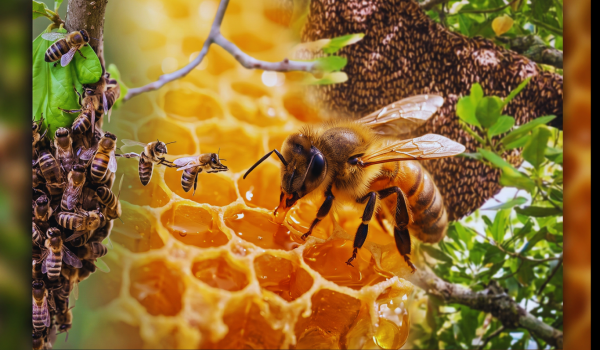
A beehive may look like a simple structure filled with buzzing insects, but inside it is a remarkably organised society. Thousands of bees work together, with each individual performing a specific role. Some collect nectar and pollen, others clean the hive, while nurse bees care for developing larvae. At the heart of this complex system is one particularly important member: the queen bee.
But how do worker bees know which bee is their queen?
For years, scientists believed that workers could recognise their queen through her unique chemical scent, or pheromones, largely because of an inborn ability. The assumption was that young bees were naturally programmed to identify the chemical signals associated with a queen.
New research is challenging that simple explanation.
Scientists studying social bees have found evidence that workers may actually learn their queen’s scent early in life. Rather than simply being born with a fixed ability to recognise one particular chemical signature, young workers may form an association between their queen and the smells they experience around her.
The discovery could change how scientists understand communication, learning and memory in social insects.
Why Is the Queen So Important to a Bee Colony?
A honeybee colony is much more than a large group of insects living together. It operates like a highly organised community in which different bees perform different jobs.
The queen has a central role because she is responsible for producing offspring. Worker bees, meanwhile, perform almost every other task needed to keep the colony alive. They gather food, build and maintain the honeycomb, feed the larvae, clean the hive, and defend the colony against threats.
That makes queen recognition extremely important.
Worker bees regularly interact with the queen and respond to chemical signals released by her body. These signals help maintain the social organisation of the colony and provide information about the queen’s presence.
The queen’s pheromones are therefore not simply a smell. They are part of a sophisticated communication system that helps hold the colony together.
The Old Idea About Queen Recognition
Scientists have long known that bees rely heavily on chemical communication.
Because the queen produces a distinctive chemical profile, researchers traditionally thought worker bees possessed an innate ability to recognise it. In simple terms, the idea was that a young worker did not need to learn what a queen smelled like. Its nervous system was assumed to be prepared to automatically identify the appropriate chemical signal.
That explanation made sense because many insect behaviours are strongly influenced by genetics and instinct.
However, the latest findings suggest that queen recognition may involve something more flexible.
Instead of responding only to a genetically programmed chemical signal, workers may use their early experiences to learn which scent belongs to their own queen.
That means experience could play a much bigger role in bee society than scientists once thought.
A Clever Experiment With Queen Bees
To investigate how workers recognise queens, researchers conducted experiments involving bumblebees, which are also highly social insects.
The basic idea was surprisingly simple.
Researchers associated a particular floral scent with a queen by placing the scent on her body. This introduced a new odour into the queen’s usual chemical environment.
The researchers then observed worker bees that had spent time developing around that queen.
Later, the workers were presented with different smells. Among the options was the same floral scent that had previously been associated with their queen.
The workers showed a stronger response to the scent connected with their own queen.
This result was significant because the floral odour was not necessarily something the workers were born programmed to recognise as a queen signal.
Instead, they appeared to have learned an association between the smell and their queen.
Do Worker Bees Actually Learn Who Their Queen Is?
This is one of the most interesting implications of the research.
If workers were completely programmed from birth to recognise a particular queen scent, adding a new smell to the queen should not necessarily make that smell important to them.
Yet the experiment suggested that workers could learn the new association.
In other words, their experience with the queen appeared to influence what they later recognised as familiar.
This points toward an important role for learning and memory.
A worker bee may encounter its queen repeatedly during the early stages of life. Over time, it could connect the queen’s chemical identity with other odours present around her. That learned information may then help the worker identify what is familiar within the colony.
The queen, therefore, may not simply be recognised through one fixed chemical message. Recognition could involve a combination of chemical signals and past experience.
What Does This Tell Us About Bee Memory?
Bees have already surprised scientists with their ability to learn.
Previous research has shown that bees can remember floral scents, learn which flowers provide valuable food and navigate between their nest and feeding locations.
They can also associate particular smells with rewards.
The possibility that they can learn information connected to their queen adds another layer to this remarkable picture.
It suggests that social behaviour in bees may not be controlled entirely by instinct.
Instead, the environment can help shape how an individual bee understands its surroundings.
This is important because social insects are often described as creatures whose behaviour is largely controlled by genetic programming. While instinct certainly plays a major role, research like this suggests that experience can also influence how they interact with their colony.
Chemical Communication May Be More Flexible Than Expected
A bee cannot communicate with other bees using human-style language. Much of its social world depends on chemical signals, touch, movement and other forms of behaviour.
Scent is especially important.
Chemical signals can help bees identify members of their colony, respond to the queen and coordinate activities inside the hive.
The new findings raise an intriguing possibility: the meaning of a chemical signal may not always be completely fixed.
A smell that becomes important to one bee because of its experience may carry a different significance for another bee.
That idea has parallels in everyday human life.
Imagine repeatedly smelling a particular perfume while spending time with someone close to you. Years later, encountering the same scent might immediately remind you of that person.
Research on bees suggests that social insects may also form associations between odours and familiar individuals or experiences.
The process is obviously not identical to human memory, but the basic concept of learning through association is fascinating.
Why This Discovery Matters
The research could have implications far beyond understanding queen bees.
First, it provides a more detailed picture of how social insects recognise important individuals within their communities.
Second, it challenges the idea that insect behaviour can always be explained as a simple genetic program.
Third, it adds to the growing body of research showing that even tiny brains can support surprisingly sophisticated forms of learning and memory.
For evolutionary biologists, the findings also raise questions about how learning developed in social animals.
Recognising members of a group is essential for many social species. Animals need to distinguish familiar individuals from outsiders, identify important members of their community and respond appropriately to different social signals.
For bees, recognising the queen is especially important because the colony’s survival and organisation depend heavily on her presence.
A Tiny Hive With a Complex Social World
A beehive may appear chaotic from the outside. Thousands of insects move constantly, flying in and out and crawling across the honeycomb.
But inside, an intricate social system is operating.
Workers divide tasks, care for young bees, gather food and maintain the nest. Chemical signals help coordinate the colony, while the queen serves as a central figure in its reproductive and social structure.
Understanding how workers recognise the queen gives scientists a closer look at the hidden complexity of bee society.
The most surprising possibility is that queen recognition may not be purely instinctive.
A worker may gradually learn what is familiar by experiencing its queen early in its life. The queen’s chemical signals can become connected with other smells and experiences, creating a form of learned recognition.
Changing the Way We Think About Bees
Bees are often viewed mainly as honey producers and pollinators. But scientific research continues to reveal a much more sophisticated side of their lives.
They can learn environmental information, remember scents, navigate over long distances and respond to complex social signals.
The discovery that learning may influence queen recognition adds another fascinating piece to that puzzle.
It suggests that the social world of bees is not governed solely by instinct. Experience can also shape how individual workers interpret chemical information around them.
That makes the humble bee even more remarkable.
The next time a bee disappears into a hive, it is worth remembering that an extraordinarily complex society is operating behind those walls. Thousands of individuals are communicating, learning and responding to one another.
And somewhere inside that buzzing world, a worker may recognise its queen not simply because it was born knowing her scent, but because it learned what that familiar scent meant.
That small distinction could lead to a much bigger understanding of how learning, memory and social communication evolved in the animal world.