


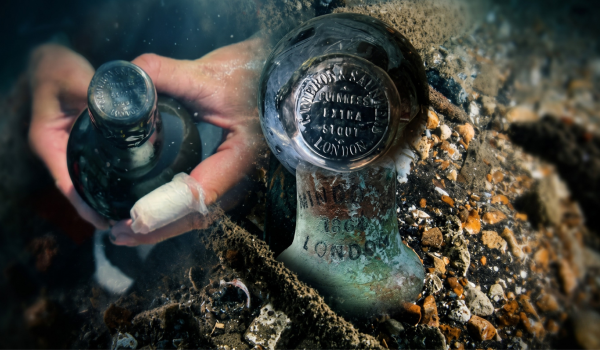
A remarkable discovery beneath the English Channel has raised an unusual question: can a bottle of Guinness beer remain drinkable after spending around 162 years underwater?
Belgian underwater photographer and shipwreck explorer Stefan Panis recovered an old glass bottle from the wreck of the Mindoro, a ship that sank near the English coast in 1864. After years of marine growth and sediment covering the bottle, cleaning revealed a familiar name: Guinness Extra Stout London.
The discovery has attracted attention not simply because of the bottle’s age, but because scientists now have an opportunity to study what may be a remarkably well-preserved example of 19th-century beer.
However, one question remains unanswered: Is the 162-year-old Guinness actually safe to drink?
An Extraordinary Discovery in the English Channel
Stefan Panis is an underwater photographer whose work often takes him into the depths of the sea to document historic shipwrecks and objects hidden beneath the water.
During a dive at the wreck of the Mindoro, Panis discovered the old Guinness bottle among the remains of the ship’s cargo.
At first, the bottle did not reveal its identity. Years underwater had covered the glass with marine deposits and grime. Once the bottle was carefully cleaned, the writing became visible.
The label identified it as Guinness Extra Stout London, providing a remarkable link to the history of one of the world’s best-known beer brands.
The Mindoro sank on November 27, 1864, after colliding with another vessel roughly three miles from Dover. The ship had been traveling from London toward Vancouver.
That means the bottle has potentially spent approximately 162 years at the bottom of the sea.
Could 162-Year-Old Guinness Still Be Drinkable?
The idea of drinking a beer brewed in the 1860s sounds almost unbelievable. Yet researchers have not completely ruled out the possibility that some of the liquid may have survived in relatively good condition.
That does not mean anyone should open the bottle and take a sip.
The key issue is the condition of the bottle’s original closure, particularly its cork.
If seawater managed to penetrate the cork over the decades, the liquid inside could have been exposed to contamination and significant chemical changes. If the cork remained sufficiently sealed, however, the beer may have been protected from direct contact with the surrounding seawater.
Researchers, therefore, need to examine the contents before making any judgment about its safety.
There is an important difference between a bottle surviving underwater and the drink inside remaining safe for human consumption.
An intact bottle is fascinating historical evidence, but it is not automatically proof that its contents are drinkable.
Why the Bottle May Have Preserved the Beer
Several factors could explain why the bottle and its contents survived for such an extraordinary length of time.
The first is the thick glass. Traditional beer bottles were built to withstand considerable pressure, and the glass could have provided an effective barrier against the surrounding environment.
The second factor is darkness. The bottle remained inside a shipwreck, away from sunlight, for more than a century and a half. Light can contribute to chemical changes in many beverages, so the absence of direct sunlight may have helped preserve the contents.
The third factor is the cork. If the original closure remained relatively effective, it could have limited the exchange between the beer and seawater.
The bottle’s position inside the ship’s cargo may also have offered additional protection from physical damage.
Even so, these conditions do not prove that the Guinness remains drinkable. Scientists must examine its chemical composition and microbiological condition before reaching a conclusion.
Scientists Are Studying More Than Just the Beer
The liquid itself is only part of the scientific interest surrounding the discovery.
Researchers are also interested in the microorganisms and yeast that may have survived inside the old beverage.
Samples have reportedly been sent to microbiologists at KU Leuven in Belgium for analysis. Scientists hope that the material could contain genetic clues about the yeast and brewing processes used during the 19th century.
This could provide an unusual window into the history of beer production.
Modern brewing has changed dramatically over the past century. Ingredients, equipment, fermentation techniques, and quality-control methods have all evolved.
If researchers can recover useful genetic information from the old sample, they may be able to learn more about the microorganisms associated with Guinness production during the 1860s.
Could scientists recreate the 1860s, Guinness?
Perhaps the most exciting possibility is that scientists could eventually attempt to recreate a beer inspired by the original 1864 Guinness.
If enough genetic information from the historic yeast can be recovered, researchers could potentially use the findings to understand the characteristics of yeast used during that period.
That does not mean scientists could simply bring the original beer back to life. Instead, they could use historical evidence to develop a modern rebrew that resembles the beer produced in the 1860s.
Such a project could give researchers and beer historians an opportunity to explore how Guinness may have tasted more than a century and a half ago.
For beer enthusiasts, the idea is fascinating. Imagine comparing a modern stout with a carefully recreated version inspired by a beer brewed in Victorian-era Britain.
However, this remains a possibility rather than a confirmed project. Much will depend on what laboratory testing reveals.
More Bottles Could Still Be Waiting Below
The discovery of one Guinness bottle may not be the end of the story.
Panis believes there may still be additional bottles hidden within the Mindoro wreck.
The bottle was reportedly found in a wooden crate, and its size suggests that the original container may have held around 24 bottles. There is also a possibility that more than one crate was carried aboard the ship.
If additional bottles are recovered, scientists could gain an even better opportunity to study the historic beer.
Multiple samples could help researchers compare how different bottles survived underwater. Some might have remained sealed, while others could have experienced seawater intrusion.
Researchers could also examine differences in chemical composition, yeast material, and the condition of individual corks.
That kind of comparison could provide much stronger evidence than studying a single bottle.
Guinness Owners Are Also Interested
The discovery has also attracted attention from Diageo, the company that owns Guinness.
The company’s archive team has reportedly contacted the divers to learn more about the discovery.
That interest is understandable. Guinness has a history stretching back centuries, and an authentic bottle from the 1860s could offer valuable historical insights.
For a global brand with such a long brewing tradition, physical evidence from the 19th century can be extremely valuable.
The bottle is more than an old container. It may provide clues about the products, packaging, and brewing practices associated with Guinness during an important period in the company’s history.
Why Underwater Beer Finds Matter to History
Shipwrecks often preserve objects that would otherwise have disappeared.
The ocean can be destructive, but certain underwater environments can also protect artifacts from sunlight, human interference, and other forms of exposure.
Researchers have previously studied alcoholic beverages recovered from historic shipwrecks because they can reveal information about old production methods and ingredients.
But scientists must approach such discoveries carefully.
A beverage that has survived for hundreds of years can undergo significant chemical changes. Microorganisms can also affect their contents, while damaged seals may allow contamination.
That is why laboratory analysis is essential before anyone considers tasting an ancient beverage.
Will Anyone Actually Drink the 162-Year-Old Guinness?
For now, there is no reason to assume that the historic Guinness is safe to drink.
Panis has indicated that he is willing to wait for scientific testing before considering whether the beer should ever be tasted.
That is the sensible approach.
Even if the bottle looks perfectly preserved, its contents have been exposed to an extraordinary underwater environment for more than a century and a half.
Scientists need to determine what is inside the bottle, whether seawater entered it, how the liquid has chemically changed, and whether potentially harmful microorganisms are present.
Only after those questions are answered could experts determine whether tasting the contents would be appropriate.
A Bottle That Connects 1864 With 2026
Perhaps the most remarkable part of this story is not whether the Guinness can still be drunk.
It is the connection the bottle creates between two completely different eras.
When the beer was produced, the world of transportation, communication, industry, and brewing looked very different from today’s world.
The Mindoro eventually sank, carrying its cargo into the darkness of the English Channel. Decades became centuries, while the bottle remained hidden beneath the sea.
Then, in the modern era, a diver recovered it.
Now, scientists have the chance to examine a small piece of everyday life from 1864.
The 162-year-old Guinness bottle could therefore become much more than a curiosity. It may provide information about historic brewing, yeast genetics, packaging, and the evolution of one of the world’s most recognizable beer brands.
And if researchers succeed in recovering useful genetic information, they may eventually get closer to answering an even more intriguing question: what did Guinness really taste like in the 1860s?
For now, the answer remains locked inside a laboratory sample.
The bottle may have survived 162 years beneath the sea, but whether its beer survived in a condition suitable for drinking is something only careful scientific testing can determine.