


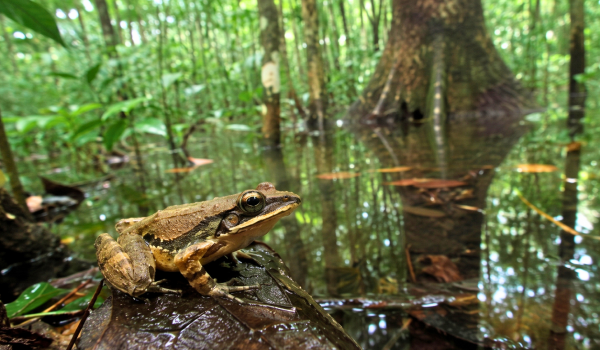
The Amazon rainforest continues to surprise scientists with discoveries that reveal just how much remains unknown about the natural world. Hidden among its rivers, wetlands, and seasonally flooded forests, researchers have identified a frog that looks remarkably similar to species already known to science.
At first glance, there appears to be little that makes this frog unusual. Its body shape and outward appearance closely resemble those of related frogs. But researchers discovered that its true identity was hiding in something humans might easily overlook: its mating call.
By combining sound recordings, genetic analysis, detailed physical measurements, and information about its habitat, scientists were able to establish that the frog represents a distinct species.
A Frog Hidden in the Amazon’s Flooded Forests
The Amazon Basin contains an enormous network of rivers, streams, wetlands, and forests. During the rainy season, rising water levels can spread into large areas of forest, temporarily turning them into flooded landscapes. When the dry season arrives, much of that water disappears again.
These seasonally flooded forests create constantly changing habitats for wildlife. Animals living there must adapt to major changes in water levels, food availability, and breeding conditions.
For scientists, however, these environments can be particularly challenging to study. Dense vegetation, difficult terrain, and seasonal flooding make many areas hard to reach.
That means animals living in these forests can remain poorly understood for years.
The newly identified frog is a good example of this hidden biodiversity. Its appearance alone did not provide enough evidence to separate it from closely related species.
Why the Frog Was Difficult to Identify
Traditionally, scientists have relied heavily on visible characteristics when identifying animals. Body size, coloration, shape, limbs, and other physical features can often reveal which species an animal belongs to.
But nature does not always make identification that simple.
Some closely related animals can evolve to look almost identical while becoming genetically distinct over long periods of time. Scientists describe these organisms as cryptic species because their differences remain hidden behind an almost identical appearance.
The newly identified Amazonian frog appears to fit this fascinating pattern.
Researchers could not simply take photographs and determine that the frog represented a new species. Instead, they had to examine several different characteristics to understand whether they were dealing with a genuinely separate evolutionary lineage.
The Mating Call Provided the First Major Clue
For frogs, sound can be just as important as appearance.
Male frogs often produce distinctive calls during the breeding season to attract females. These calls can contain species-specific characteristics, including differences in pitch, frequency, duration, rhythm, and repetition.
To human ears, two frog calls might sound similar. But detailed acoustic analysis can reveal differences that are difficult to hear without scientific equipment.
In this case, researchers noticed that the frog’s mating call did not fully match those of similar-looking species.
That discovery immediately raised an important possibility: the frog might not simply be a variation of an already known species.
Its voice suggested that a bigger biological difference might lie beneath its familiar appearance.
DNA Analysis Strengthened the Discovery
A different call alone is not enough to establish a new species.
Scientists, therefore, turned to genetic evidence. By examining the frog’s DNA and comparing it with that of closely related species, researchers could investigate how closely the animals were connected.
The genetic results supported the initial evidence from the frog’s call. Although the newly identified frog shared similarities with related species, its genetic characteristics showed important differences.
This indicated that the frog had followed its own evolutionary path.
In other words, two frogs could look almost identical on the outside while their DNA reveals that they have been separated for a significant period of evolutionary history.
Modern genetic techniques have made it possible for scientists to uncover precisely these kinds of hidden relationships.
Tiny Physical Differences Also Matter
Genetics and sound were not the only pieces of the puzzle.
Researchers also carefully examined the frog’s physical characteristics. Measurements of its body, limbs, and other anatomical features were compared with those of closely related species.
The differences were not necessarily dramatic.
That is exactly what makes cryptic species so interesting.
A species does not need to develop a completely different color pattern or dramatically different body shape to become evolutionarily distinct. Small changes accumulated over generations can eventually separate one population from another.
When scientists combine many subtle characteristics, those small differences can become powerful evidence.
Its Habitat Adds Another Piece to the Puzzle
Where an animal lives can also provide valuable information about its identity.
The newly recognized frog was found in seasonally flooded forests of the western Amazon. These forests experience major changes throughout the year as water levels rise and fall.
Such environmental conditions can influence how animals feed, reproduce, and move through their surroundings.
Scientists are therefore interested in understanding how the frog uses this changing habitat. Questions about where it breeds, what conditions it prefers, and how it responds to seasonal flooding could provide further insight into its biology.
Its environment may also help explain why the species remained difficult to distinguish from its relatives.
Evolution Does Not Always Change an Animal’s Appearance
One of the most fascinating lessons from this discovery is that evolution is not always obvious to the human eye.
People often imagine that a new species must look dramatically different from its closest relatives. In reality, evolution can produce much more subtle changes.
Two species may retain almost identical appearances while becoming increasingly different genetically and behaviorally.
Their calls may change.
Their breeding habits may differ.
They may prefer different habitats.
Their DNA may reveal separate evolutionary histories.
This is why scientists increasingly use a combination of evidence rather than relying on appearance alone.
Modern Technology Is Changing Species Discovery
Advances in biology have transformed the way scientists identify wildlife.
Audio-recording equipment allows researchers to capture animal calls in remote environments. Genetic sequencing can reveal relationships that cannot be detected through photographs. Detailed measurements can uncover tiny physical differences.
When these methods are combined with observations of habitat and behavior, scientists gain a much clearer picture of an animal’s identity.
This approach is particularly valuable in biodiversity hotspots such as the Amazon, where large numbers of species may live in relatively small areas, and many remain poorly studied.
A frog that once might have been classified as an ordinary member of a known species can now be investigated in far greater detail.
The Amazon May Still Be Hiding More Species
The discovery also highlights how much remains unknown in the Amazon rainforest.
The region is one of the most biologically diverse places on Earth, yet large areas remain difficult to explore. Some forests are extremely remote, while others become flooded for months at a time.
Researchers cannot easily conduct fieldwork in every location year-round.
As a result, there may be many more animals waiting to be properly identified.
Some could be completely unknown species. Others may already be known but could contain hidden cryptic species that scientists have not yet recognized.
The discovery of this frog demonstrates why continued field research is so important.
A Mating Call That Revealed a Hidden Identity
The story of this Amazonian frog is ultimately a reminder that nature does not always reveal its secrets through appearance.
A frog may look familiar, yet its voice can tell a completely different story.
Its DNA can provide another clue.
Its anatomy can reveal subtle differences.
And its habitat can add another layer of evidence.
Only by bringing all these pieces together can scientists understand the animal’s true identity.
The discovery, therefore, represents more than the identification of another frog. It is another glimpse into the enormous biological diversity of the Amazon and a reminder that even in one of the world’s most studied ecosystems, nature still has plenty of secrets left to uncover.
Sometimes, the most important clue is not something scientists can see at all. Sometimes, a single mating call can reveal an entirely different species.