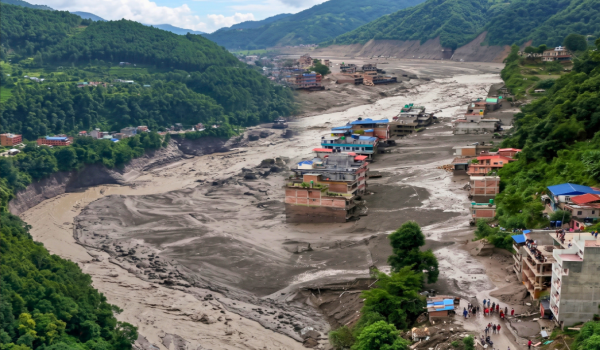



A devastating flash flood and landslide along the Nepal-Tibet border has killed more than 100 people and left hundreds of others missing, including foreign tourists and pilgrims traveling through the Himalayan region.
The disaster struck on Wednesday, August 26, after a huge surge of water, mud, and debris swept through parts of Nepal’s Rasuwa district and neighboring areas. The flooding also caused major destruction in Tibet, where Chinese authorities reported deaths, and hundreds of people were unaccounted for.
The scale of the disaster continued to change as rescue teams reached areas that had been cut off by destroyed roads, bridges, and communication networks. Reuters later reported that at least 157 people had died on the Nepali side, while Chinese authorities reported three deaths in Tibet.
Hundreds of Tourists Remain Missing
One of the biggest concerns is the large number of tourists and pilgrims who lost contact with one another after the flood.
Earlier updates from the Nepal Tourism Board put the number of missing travelers at 384, including 291 foreign nationals and 93 Nepali citizens. Indian nationals formed the largest group among the missing foreign travelers, with 105 initially reported missing.
As authorities continued to check information from tour operators, police, and local officials, later reports indicated that the number of people unaccounted for had risen significantly. Reuters reported that more than 400 tourists were missing, while other reports cited even higher numbers as authorities worked to reconcile different lists.
The missing include people from India, the United States, Britain, Australia, Canada, Malaysia, and several other countries. Many were traveling along routes connected with religious and tourism destinations such as Mount Kailash and Lake Mansarovar.
The Nepal Tourism Board has been coordinating with tourism agencies, security forces, and local authorities to identify missing travelers and establish their whereabouts.
What Caused the Nepal Flash Flood?
The exact chain of events behind the disaster remains under investigation.
Initial reports suggested that an earthquake may have triggered the catastrophe. Nepal’s authorities initially linked the disaster to seismic activity and a subsequent avalanche or landslide.
However, later analysis complicated that explanation.
The U.S. Geological Survey initially recorded a magnitude 4.4 seismic event in the region, but subsequent analysis indicated that the reported signal could actually have been produced by a massive landslide rather than an earthquake. Other experts have also been examining the possibility that an ice avalanche or glacial event blocked a river before the accumulated water and debris suddenly burst downstream.
This distinction is important because the Himalayan region contains unstable slopes, glaciers, and glacial lakes. A sudden collapse of ice, rock, or water can create an enormous debris flow within minutes.
Nepal also experienced a similar Bhotekoshi flood in July 2025, when authorities concluded that a glacial lake outburst had caused flooding near the Nepal-China border.
Rasuwa and Nearby Districts Devastated
Rasuwa was among the worst-hit areas. The flood swept through communities along the Bhotekoshi River before affecting downstream areas.
Nuwakot, Dhading, Chitwan, Gorkha, Tanahun, and Nawalpur were also affected, with deaths reported across several districts.
Homes, businesses, roads, and bridges were washed away or badly damaged. Important border infrastructure and hydropower facilities were also hit.
Nepal’s authorities reported damage to at least 19 bridges and around 40 kilometers of roads in an earlier assessment.
The destruction of roads has created another major problem: rescue teams cannot easily reach isolated communities.
Bad weather and damaged infrastructure have also made helicopter operations difficult in some locations.
Security Forces and Workers Also Missing
The disaster has affected more than tourists.
Nepalese police, army personnel, and armed police officers were among those who lost contact during the flooding. Workers associated with hydropower projects were also reported missing.
The country’s power infrastructure suffered significant damage, while customs and immigration facilities near the border were also affected.
The destruction is particularly serious because the Rasuwa area is strategically important for trade between Nepal and China. The Rasuwagadhi border crossing and surrounding transport links were badly affected.
Nepal’s government has been coordinating rescue and relief operations while also working with neighboring China.
Severe Damage Reported in Tibet
The disaster did not stop at the Nepal-China border.
In China’s Tibet Autonomous Region, the Gyirong area was also hit by landslides and powerful mudflows. Chinese state media reported three deaths and 265 people missing in the region.
The Gyirong border area is an important trade and transport route between China and Nepal. Floodwaters and landslides damaged buildings and infrastructure, making movement extremely difficult.
Chinese authorities activated emergency response measures and prepared helicopters, transport aircraft, and drones to support rescue and monitoring operations.
Aerial surveillance was used to assess areas that rescuers could not safely reach by road.
India Issues Flood Warning
The disaster also raised concerns in neighboring India.
Authorities in Bihar warned residents about the possibility of rising water levels in the Gandak River system as floodwaters moved downstream from the Himalayan region.
Officials increased monitoring of embankments and prepared emergency response teams. Night patrols and evacuation plans were also considered in vulnerable areas.
The concern is that a major upstream disaster can quickly create dangerous conditions far beyond the original flood zone.
South Korean Workers Among Those Affected
South Korea has also been monitoring the situation after several of its citizens lost contact in the affected area.
According to South Korean authorities, eight nationals working on a hydropower construction project could not initially be reached. Another group of South Korean citizens was reportedly stranded and waiting for rescue.
Nepal authorities arranged helicopter assistance to help reach people trapped by the destruction.
The situation highlights how the flood has affected not only tourists but also foreign workers involved in major infrastructure projects across the Himalayan region.
Rescue Operations Face Huge Challenges
Nepal’s security forces have deployed helicopters and personnel to search for survivors and missing people.
But the rescue operation is extremely difficult.
Large sections of roads and bridges have disappeared. Communication networks have been disrupted, while unstable slopes and continuing bad weather are creating additional risks for rescuers.
In some areas, entire settlements have been covered by mud and debris, making it difficult to determine how many people remain trapped.
Rescue teams must therefore work carefully while trying to reach isolated communities as quickly as possible.
A Major Himalayan Disaster
The Nepal-Tibet flash flood has become one of the region’s most serious recent natural disasters.
The rapidly changing death and missing-person figures show just how difficult it is to assess the full scale of the destruction.
The tragedy has also renewed concerns about the growing risks faced by communities living in the Himalayas. Glacial lakes, unstable mountains, landslides, and sudden changes in water flow can create devastating floods with very little warning.
For now, the priority remains clear: finding missing people, rescuing survivors, and restoring access to communities cut off by the disaster.
As rescue teams continue their work, authorities in Nepal, China, and neighboring India are also watching for further flooding, landslides, and other secondary hazards.
The final human and economic cost of the Nepal-Tibet disaster may take days or even weeks to establish.