


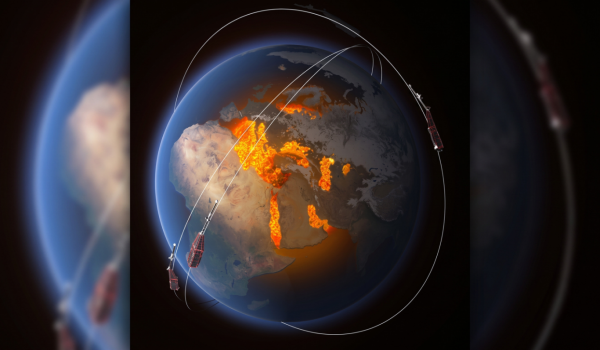
Scientists studying Earth’s deepest interior have detected an unusual change in the movement of molten metal inside the planet’s outer core. A portion of the liquid iron flow, which has traditionally been associated with westward movement, appears to be showing an eastward trend beneath the Pacific Ocean.
The discovery is giving researchers a fresh look at the mysterious processes taking place thousands of kilometers beneath our feet. Because humans cannot directly reach or observe Earth’s outer core, scientists rely on indirect clues, including changes in the planet’s magnetic field and measurements collected by satellites.
The latest findings do not mean that Earth is suddenly facing a major magnetic crisis. Instead, they provide another important piece of evidence about how the planet’s interior works and how its magnetic environment changes over time.
What Is Happening Deep Inside Earth?
Earth is made up of several major layers, including the crust, mantle, outer core, and inner core. The outer core begins roughly 2,900 kilometers below the surface and consists largely of extremely hot, liquid iron mixed with other elements.
Conditions in this region are extreme. Temperatures are enormous, pressure is immense, and the liquid metal is constantly moving.
That movement matters because the outer core plays a central role in generating Earth’s magnetic field. As electrically conductive liquid metal moves within the outer core, it produces complex electrical currents. These currents contribute to the magnetic field that surrounds our planet.
Scientists, therefore, pay close attention to even subtle changes in the behavior of this molten material.
A Strange Eastward Movement
For decades, researchers have identified large-scale patterns in the movement of liquid metal within Earth’s outer core. One important component of that motion has generally been associated with westward movement.
Recent observations, however, indicate that part of the flow may be slowing and developing an eastward component.
The finding is particularly interesting beneath the Pacific Ocean, where changes in Earth’s magnetic field have provided clues about what could be happening deep below the surface.
It is important to understand that scientists are not directly watching a river of molten iron turn around. Instead, they are studying changes in the magnetic signals produced by activity inside the core.
Those signals allow researchers to construct models of the movement occurring far below the depths reached by humans in their deepest drilling projects.
How Can Scientists Study Earth’s Outer Core?
Studying the outer core is one of the biggest challenges in modern Earth science. The region lies thousands of kilometers beneath the surface, making direct observation impossible with current technology.
Scientists instead use measurements of Earth’s magnetic field as a kind of window into the planet’s interior.
Satellites operated by organizations such as the European Space Agency have helped researchers monitor tiny variations in Earth’s magnetic field. These observations can reveal changes that originate deep within the planet.
By comparing magnetic measurements collected over many years, scientists can identify patterns and determine whether particular features are becoming stronger, weaker, or changing direction.
This approach does not provide a perfect picture of the outer core, but it gives researchers valuable evidence about its hidden movements.
The Change Has Been Developing for Years
Although the recent findings may sound sudden, researchers have been watching changes in core flow for many years.
Around 2010, scientists began observing signs that some westward-moving features in the outer core were slowing down. At the same time, indications of eastward movement gradually became more noticeable.
The latest observations have added to that evidence and raised new questions about whether the change represents a temporary fluctuation or part of a longer-term process.
That distinction is extremely important.
Earth’s interior does not behave like a simple machine with fixed settings. Its conditions are constantly changing, and movements inside the outer core can evolve over time.
Scientists, therefore, need long-term observations to determine exactly what is happening.
Why Does Molten Iron Matter to Earth’s Magnetic Field?
Earth’s magnetic field is invisible, but it is essential to the planet’s environment.
The Sun constantly releases charged particles and radiation into space. Some of this material reaches Earth, while our magnetic field helps deflect a significant portion of the incoming solar particles.
The magnetic field also makes modern navigation systems possible in various ways. The familiar compass, for example, responds to Earth’s magnetic field.
More broadly, the magnetic environment affects how Earth interacts with the solar wind and other conditions in near-Earth space.
Because the outer core helps generate this magnetic shield, changes in the movement of molten metal are scientifically important.
However, a change in core flow does not automatically mean that Earth’s magnetic field is about to collapse or become dangerously weak.
Could Earth’s Magnetic Field Become Weaker?
The discovery naturally raises an important question: could the unusual movement of molten iron weaken Earth’s magnetic field?
At present, scientists do not have enough evidence to make such a direct conclusion.
Earth’s magnetic field is controlled by an extremely complicated system involving the movement of liquid metal, heat transfer, pressure, density, electrical currents, and the planet’s rotation.
A change in one part of the system does not necessarily produce an immediate or dramatic change in the entire magnetic field.
Instead, researchers are interested in understanding how these internal changes contribute to the field’s natural variations over years, decades, and much longer periods.
The Role of Earth’s Rotation
Earth’s rotation is another important factor in understanding the outer core.
The planet spins continuously, and that rotation influences how liquid metal moves inside the outer core. Heat rising from deeper regions and cooler material moving downward can also create complex circulation patterns.
The interaction between these processes produces a highly dynamic environment.
That is why scientists cannot simply point to a single cause to explain the unusual eastward movement. Several physical processes may be working together.
Researchers need more observations and improved computer models to determine which mechanisms are responsible.
Why the Pacific Ocean Region Matters
The Pacific Ocean itself is not causing the molten iron to change direction. Rather, the region is important because magnetic measurements collected above it can reveal features associated with processes occurring deep below.
Scientists study geographical variations in Earth’s magnetic field to understand how different parts of the outer core behave.
Some magnetic signals change relatively quickly, while others develop over much longer periods. Mapping these changes can help researchers reconstruct movements inside the liquid core.
The Pacific region is therefore one piece of a much larger global picture.
A New Clue About Earth’s Hidden Interior
The unusual molten iron flow is valuable because it gives scientists another clue about the planet’s internal machinery.
Earth may appear stable from the surface, but deep inside, enormous amounts of liquid metal are constantly moving under extraordinary conditions.
These hidden movements influence the magnetic field surrounding the planet. By studying them, researchers can learn more about how Earth formed, how its interior evolved, and how its magnetic environment behaves.
The discovery could also help scientists improve models of the geodynamo, the complex process responsible for generating Earth’s magnetic field.
Better models could eventually help researchers understand changes in magnetic field strength and structure more accurately.
Scientists Still Have More Questions Than Answers
Despite the exciting discovery, researchers remain cautious.
The evidence does not yet provide a complete explanation for why the molten iron appears to be moving eastward. It is also unclear how long the current pattern will continue.
The outer core is so difficult to study that scientists must combine observations from satellites, ground-based magnetic measurements, and mathematical models.
Each new set of observations can therefore change or improve our understanding of what is happening deep underground.
Long-term monitoring will be especially important. If the eastward trend continues for decades, it could indicate a significant feature of the outer core’s natural dynamics. If it reverses again, it could demonstrate how rapidly these deep processes can change.
Earth’s Deepest Mystery Continues
The strange movement of molten iron beneath the Pacific is not a sign that Earth is suddenly in danger. Instead, it is a fascinating reminder that our planet remains active far beneath the surface.
Scientists cannot travel to the outer core, but Earth’s magnetic field provides an indirect way to investigate this inaccessible world.
The apparent slowdown of westward flow and emergence of an eastward component could ultimately reveal more about the forces driving Earth’s magnetic field.
For now, the mystery remains open. Researchers will continue collecting satellite observations, analyzing magnetic changes, and improving models of the planet’s interior.
What appears to be a hidden river of molten metal moving thousands of kilometers below our feet could hold important clues about how Earth works. As scientists learn to read those clues, they may come closer to understanding one of the greatest mysteries beneath the surface of our planet.