


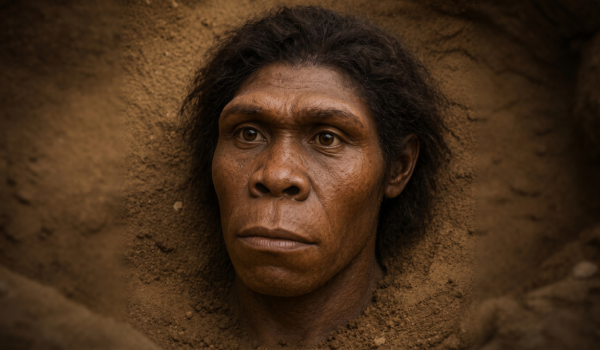
A remarkably old fossil from Ethiopia is giving scientists a fresh reason to question what they thought they knew about human evolution. Dating to around 1.5 to 1.6 million years ago, the fossilized skull has a fascinating mix of features. Some appear strongly connected to Homo erectus, while others look much older and resemble traits seen in earlier human ancestors.
That unusual combination could help researchers understand how early humans evolved, moved across Africa, and eventually spread into other parts of the world.
The discovery does not provide a final answer about where modern humans came from. Instead, it adds another important piece to an increasingly complicated evolutionary puzzle.
A 1.5-Million-Year-Old Face Frozen in Time
The fossil, known as DAN5/P1, was discovered in the Gona region of Ethiopia. Researchers estimate that it is approximately 1.5 to 1.6 million years old, placing it deep in the Early Pleistocene.
At first glance, the remains might appear to be another example of early Homo erectus, one of the most important species in the story of human evolution. Homo erectus is widely recognized for having a more human-like body and larger brain than earlier members of the human family.
However, the face of DAN5/P1 tells a more complicated story.
The fossil contains parts of the face, teeth, and skull, but researchers did not find everything neatly preserved as a single complete specimen. Instead, different fragments had become separated over hundreds of thousands of years.
Scientists, therefore, had to carefully reconstruct the skull before they could study its shape in detail.
Scientists Reconstructed the Skull Digitally
Modern technology played an important role in understanding the ancient fossil.
Researchers used high-resolution micro-CT scanning to examine the fossil fragments. This technology allowed them to create detailed digital models of the individual pieces without physically altering the fragile remains.
Once the digital models were available, scientists could virtually reposition the fragments and reconstruct a much more complete version of the skull.
This type of virtual reconstruction is becoming increasingly valuable in palaeoanthropology. Fossils are often damaged, incomplete, or scattered when they are discovered. Digital technology can help researchers examine their original structure and compare it with other ancient human fossils.
In the case of DAN5/P1, the reconstructed skull offered researchers a rare opportunity to examine the facial anatomy of an early human from the Horn of Africa.
A Strange Mix of Ancient and Homo Erectus Features
The most interesting part of the discovery is the combination of characteristics found in the skull.
Several features of the braincase appear consistent with Homo erectus. But the face and teeth show characteristics that seem to retain similarities with even earlier members of the human lineage.
That combination is important because evolution does not always happen in a simple, straight line.
Imagine a family tree where every generation simply replaces the previous one. Human evolution may have looked much more complicated than that. Different populations could have existed simultaneously, with some developing new characteristics while retaining older ones.
DAN5/P1 may represent exactly this kind of evolutionary mixture.
Rather than showing a clean transition from one species to another, the fossil suggests that different anatomical traits could have appeared at different speeds in different populations.
What the Fossil Could Tell Us About Homo Erectus
Homo erectus occupies a major place in the history of human evolution. The species lived for a very long period and is associated with important developments in human anatomy and behavior.
Researchers have long studied when and where Homo erectus first appeared and how populations connected across Africa and beyond.
The Ethiopian fossil could add another layer to that story.
If the facial features of DAN5/P1 preserve older characteristics while the braincase resembles Homo erectus, it raises questions about how quickly different parts of the human body evolved.
The face, teeth, and braincase may not have changed together at exactly the same time. Instead, early human populations may have experienced a gradual mixture of anatomical changes over long periods.
That possibility could challenge overly simple ideas about the emergence of Homo erectus.
Human Evolution May Have Been More Complicated Than We Thought
For decades, popular explanations of human evolution have often presented the process as a relatively straightforward sequence. One species appears, gradually changes, and is replaced by another.
The fossil record tells a different and much more complicated story.
Ancient human populations often overlapped in time. Different groups could live in separate parts of Africa while developing their own physical characteristics. Some populations may have retained older traits even as newer features appeared elsewhere.
The DAN5/P1 skull fits into this more complex picture.
Its unusual combination of anatomical features suggests that early human evolution may have involved multiple populations changing at different rates rather than one single group following a perfectly predictable path.
This is especially important when researchers try to understand the origins and early spread of Homo erectus.
Why Ethiopia Is So Important to Human Evolution
Ethiopia has played an enormous role in the study of human origins.
The region contains some of the world’s most significant archaeological and fossil sites, offering evidence of ancient human ancestors stretching back millions of years.
The Gona area is particularly valuable because it has produced fossils and archaeological remains that help researchers investigate life during the Early Pleistocene.
Finding a relatively complete early human skull in this region gives scientists another opportunity to compare populations living in Africa during a critical period of evolution.
The better researchers understand these ancient populations, the more clearly they can reconstruct how our distant ancestors adapted to changing environments and expanded into new regions.
The Mystery of Early Human Migration
The fossil also raises questions about how early humans moved across Africa and eventually beyond the continent.
Homo erectus is often associated with some of the earliest major movements of human ancestors outside Africa. But understanding exactly how these populations emerged and spread remains difficult.
A fossil with mixed anatomical characteristics can help scientists test different theories.
Perhaps some populations developed Homo erectus-like features independently or at different times. Perhaps older populations survived alongside newer groups for much longer than previously assumed. There may also have been interactions between different groups across Africa.
At this stage, researchers cannot say which explanation is correct.
What DAN5/P1 does show is that the evolutionary story is unlikely to be as simple as a single population changing in one place and then spreading everywhere.
One Ancient Face, Many New Questions
The 1.5-million-year-old skull does not rewrite the entire history of humanity overnight. Science rarely works that way.
Instead, discoveries like DAN5/P1 gradually change the questions researchers ask.
The fossil provides evidence that early human populations could display a surprising mixture of old and new anatomical characteristics. It also demonstrates why incomplete fossils can become extremely valuable when modern imaging and computer reconstruction techniques are applied to them.
For scientists, the greatest value of the discovery may not be the answers it provides but the questions it raises.
Where exactly did Homo erectus emerge? How quickly did its defining characteristics develop? Did several populations evolve similar features at different times? And how were these ancient groups connected as they moved through Africa and eventually into other parts of the world?
These questions remain open.
A New Chapter in the Story of Human Evolution
DAN5/P1 is a powerful reminder that the human evolutionary story is still being written.
A skull that spent roughly 1.5 million years buried in the Ethiopian landscape has now become a window into a distant world. Its combination of facial, dental, and braincase features suggests that the emergence of Homo erectus may have involved more complexity than traditional models suggest.
The discovery does not overturn everything scientists know about human evolution. Instead, it adds another important piece to the puzzle and encourages researchers to look beyond simple evolutionary timelines.
The face may be ancient, but the questions it raises are remarkably modern.
As more fossils are discovered and new technologies allow scientists to study them in greater detail, our understanding of where we came from will continue to evolve. And sometimes, one mysterious face from the distant past is enough to make scientists rethink the entire family tree.