


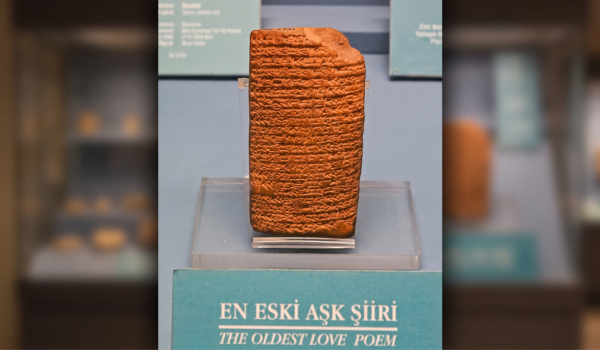
A Love Song Written in Clay
Love may be one of humanity’s oldest stories, but few reminders of its enduring power are as striking as a 4,000-year-old poem preserved on a simple clay tablet.
The ancient Sumerian text, known as “The Love Song of Shu-Sin,” has survived thousands of years to offer a rare glimpse into the emotions, relationships, and poetic traditions of one of the world’s earliest civilizations. Though the words were written in a very different age, the feelings behind them remain surprisingly familiar.
The remarkable ancient poem was recently brought to wider attention by distinguished Assamese writer, poet, literary critic, and retired Director General of Police of Assam, Harekrishna Deka, who shared an insightful post about the historic text on Facebook.
Writing in Assamese, Deka introduced readers to the ancient Sumerian love poem, along with his own Assamese translation and scholarly observations. His presentation created a fascinating connection between an ancient Mesopotamian literary tradition and modern Assamese readers.
The Love Song of Shu-Sin
“The Love Song of Shu-Sin” is associated with the Sumerian civilization of ancient Mesopotamia, a region often described as one of the earliest centers of urban civilization and written culture.
The poem is believed to have been composed around the beginning of the second millennium BCE. It celebrates love, desire, and intimacy through poetic language, offering historians and literary scholars a rare window into the emotional world of ancient Sumer.
What makes the text particularly fascinating is that it is not simply a historical record. It is a work of literature.
Thousands of years after it was first written, the poem still speaks about emotions that people understand today. Love, longing, attraction, and affection are not modern inventions. They are part of the human experience, and the ancient clay tablet provides powerful evidence of that continuity.
A Message That Survived 4,000 Years
Imagine a poet sitting in ancient Mesopotamia, expressing deeply personal emotions and recording them on clay without knowing that people thousands of years later would still read the words.
That is what makes ancient literature so extraordinary.
Unlike modern books, clay tablets could not be easily reproduced or distributed. Yet some survived wars, changing kingdoms, natural decay, and the passage of countless generations.
“The Love Song of Shu-Sin” therefore represents more than an ancient romantic poem. It is also a surviving piece of human memory.
The people who created it lived in a world without modern technology, newspapers, social media, or printing presses. Yet their emotional vocabulary was not entirely different from ours. Their methods of communication have disappeared, but their feelings remain recognizable.
Harekrishna Deka Connects Ancient Sumer With Assam
Harekrishna Deka’s contribution adds another important layer to the story.
Known for his literary work and critical engagement with language and culture, Deka presented the ancient Sumerian poem to Assamese readers through his own translation and accompanying notes.
Translation is never simply a matter of replacing words from one language with words from another. Poetry makes the challenge even greater because rhythm, emotion, cultural references, and subtle meanings all have to travel together.
By bringing the Sumerian love song into Assamese, Deka created a bridge between two distant literary worlds.
On one side stands ancient Sumer, with its clay tablets and cuneiform writing. On the other hand is Assam, with its rich and diverse literary tradition.
The distance between the two cultures is enormous in geography and time. Yet poetry provides a common language.
Why Ancient Love Poetry Still Matters
It is easy to think of ancient history as something distant and disconnected from everyday life. Archaeological discoveries, old inscriptions, and forgotten civilizations can sometimes feel like pieces of a world that has nothing to do with the present.
Ancient love poetry challenges that idea.
A poem about affection and longing can make a person living thousands of years later feel unexpectedly close to its original author. The details of life may have changed, but the emotions can remain remarkably familiar.
This is one reason ancient literature continues to attract historians, archaeologists, and literary scholars.
Texts such as “The Love Song of Shu-Sin” help researchers understand more than the language of an extinct civilization. They also provide clues about social relationships, cultural traditions, religious beliefs, and ideas about love and intimacy.
From Clay Tablet to Modern Audience
The journey of this ancient poem is almost as remarkable as the poem itself.
It began as writing pressed into wet clay in ancient Mesopotamia. The marks were created using a writing system known as cuneiform, one of the earliest known forms of writing.
The tablet survived long after the civilization that produced it changed and disappeared.
Centuries became millennia.
Then modern scholars studied and translated the ancient writing, allowing its meaning to reach audiences around the world.
Deka’s Assamese translation represents another stage in that extraordinary journey. A poem once preserved in clay can now reach readers in a completely different linguistic and cultural environment.
That transformation shows the remarkable ability of literature to cross borders.
The Timeless Nature of Human Emotion
Technology changes. Languages evolve. Cities rise and disappear. Political systems come and go.
Human emotions, however, often remain remarkably constant.
That may be the most powerful lesson contained within this 4,000-year-old love song.
The ancient Sumerians lived under conditions that were vastly different from modern life. Yet they experienced affection, desire, attachment, and longing much as people do today.
This shared emotional experience gives ancient literature its unusual power.
When readers encounter a poem written thousands of years ago and recognize something of themselves in it, history suddenly becomes personal.
The clay tablet is no longer merely an archaeological object. It becomes a voice.
A Literary Bridge Across Millennia
Harekrishna Deka’s presentation of “The Love Song of Shu-Sin” demonstrates how literature can connect people across extraordinary distances of time and place.
A Sumerian poet could never have imagined that their words would one day be translated into Assamese and discussed by modern readers. Yet that is precisely what has happened.
The poem has traveled from ancient Mesopotamia to the modern world, carrying with it a simple but enduring message: human beings have always searched for ways to express what they feel.
Perhaps that is why a piece of writing pressed into clay 4,000 years ago can still attract attention today.
The tablet may be ancient, but the emotion is not.
And somewhere between the ancient marks on clay and the modern Assamese translation lies a reminder that literature can make even the most distant past feel remarkably close.
In the end, “The Love Song of Shu-Sin” is more than a 4,000-year-old love poem. It is a surviving conversation between generations of humanity — a quiet voice from the ancient world still speaking to us today.