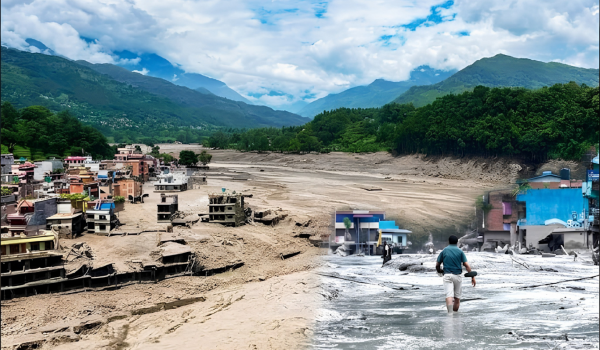


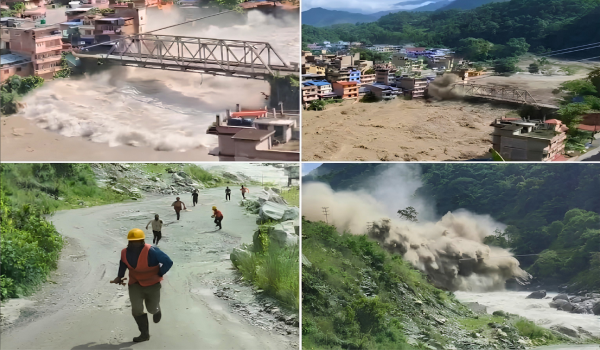
A terrifying video showing workers running for their lives as a powerful flash flood surges through a Himalayan valley in Nepal has gone viral on social media. The dramatic footage appears to capture the terrifying speed and force of a sudden torrent carrying mud, water, and debris through a construction area.
The incident comes amid reports of severe flooding and landslides in parts of northern Nepal near the border with Tibet, where sudden surges in mountain rivers have caused widespread destruction.
The viral footage shows just how little time people can have to escape when a flash flood strikes in a mountainous region.
Workers Flee as Huge Flash Flood Approaches
According to the video shared on social media, several workers were carrying out construction work when they suddenly noticed a huge wall of muddy water rushing towards them.
The torrent appears to emerge from a mountain valley with enormous force. As the workers realize the danger, they immediately abandon their work and begin running towards safer ground.
The muddy water can be seen moving rapidly through the area, carrying debris and sediment along. The workers appear to understand that even a few seconds could make the difference between escaping and being swept away.
The footage was reportedly recorded by one of the workers. Because the video was filmed from relatively close to the advancing flood, the scale and speed of the water are particularly frightening.
The authenticity and exact location of the video have not been independently verified by PageOneLive.com.
Viral Video Shows Terrifying Force of Nepal Flood
A video posted on X by an account identified as ‘Surajit_Ghosh2’ reportedly shows the workers reacting to the approaching flood.
The footage captures a large volume of muddy water racing through the valley. The torrent appears to rise several feet in places as it moves across the landscape, striking areas on both sides of the river.
With the water advancing so quickly, the workers are seen running away from the construction site.
The scene highlights one of the biggest dangers associated with flash floods in mountainous areas. Unlike ordinary flooding, flash floods can develop extremely quickly, giving people little opportunity to move to higher ground.
A sudden increase in water from higher elevations can also carry rocks, trees, soil, and other debris. This makes the advancing flow far more destructive than water alone would be.
Another Video Shows Bridge Swept Away
Another video circulating online reportedly shows the destructive power of the flood in a populated area.
In the footage, a powerful torrent rushes through the settlement, overflowing the river and surrounding areas. A metal bridge connecting the two sides of the river appears to be overwhelmed by the force of the water.
The structure is reportedly being dragged away by the raging current, demonstrating the enormous force generated by the sudden flood.
Buildings near the river are also shown surrounded by fast-moving muddy water. The torrent carries debris through the settlement as residents face the threat of further flooding.
Such scenes have raised concerns about the vulnerability of communities living close to rivers in Nepal’s mountainous regions.
Rasuwa and Nearby Areas Among the Worst Hit
Reports cited in connection with the disaster say areas of the Rasuwa district, including Timure and Syabrubesi, have suffered significant damage.
The region lies close to Nepal’s northern border with Tibet and is surrounded by steep Himalayan terrain. Rivers in such areas can rise rapidly following intense rainfall or sudden releases of water from higher elevations.
The Bhote Koshi river system has been particularly associated with the reported flooding.
Local residents living along riverbanks have been urged to remain alert and move to safer locations when necessary.
The combination of steep mountains, narrow valleys, heavy rainfall, and unstable slopes can make communities in the Himalayan region especially vulnerable to sudden flooding and landslides.
Rescue Teams Search Through Mud and Debris
The disaster has also created major challenges for rescue teams.
In areas where floodwater has left thick layers of mud and sediment covering roads, buildings, and other structures, rescuers have had to search through debris for missing people.
Floodwaters can rapidly transform roads and settlements into dangerous fields of mud and wreckage. Heavy debris can also damage bridges and block access routes, making rescue operations more difficult.
Authorities and emergency workers therefore face a race against time when searching for people who may have been trapped by the flooding.
The full extent of the destruction remains difficult to determine while search and rescue operations continue.
Conflicting Reports Over Casualties
Different reports circulating about the disaster have provided varying casualty figures.
Some reports have cited a relatively limited number of confirmed deaths in the initial stages of the incident, while other reports have claimed that the death toll across the affected areas was substantially higher.
There have also been reports of missing people and tourists whose whereabouts were initially unknown.
Because rescue operations and official assessments can change rapidly after a major natural disaster, casualty figures should be treated cautiously until confirmed by Nepalese authorities or other reliable sources.
The number of people buried beneath mud and debris also remains uncertain in areas where buildings and roads have been heavily damaged.
Why Flash Floods Are So Dangerous in the Himalayas
Flash floods are particularly dangerous in mountainous terrain because water can travel downhill at tremendous speed.
When intense rainfall occurs higher up in a mountain catchment, huge quantities of water can enter streams and rivers within a short period. The steep landscape accelerates the flow as it moves towards lower elevations.
The water can also pick up loose soil, rocks, and other debris along the way. This creates a destructive mixture capable of damaging bridges, roads, and buildings.
For people working or living close to mountain rivers, there may be very little warning before the water arrives.
The viral video of the Nepalese workers running from the advancing torrent offers a dramatic illustration of this danger. What initially appears to be a distant surge can become an immediate life-threatening situation within moments.
A Warning for Communities Near Mountain Rivers
The frightening footage also underlines the importance of early warnings and evacuation plans in areas exposed to flash floods.
People living near rivers and in low-lying sections of narrow valleys are particularly vulnerable. When authorities issue evacuation warnings, residents are advised to move to higher, safer ground rather than wait to see how severe the flooding becomes.
The latest videos emerging from Nepal show how quickly conditions can change during a Himalayan flash flood.
For the workers seen in the viral footage, immediate action appears to have been crucial. Their decision to run as soon as they saw the approaching torrent may have saved their lives.
As rescue and recovery efforts continue, authorities are expected to assess the damage and determine the disaster’s final impact.
The terrifying videos serve as a stark reminder of the unpredictable power of nature—and how quickly a peaceful mountain valley can become a deadly flood zone.