


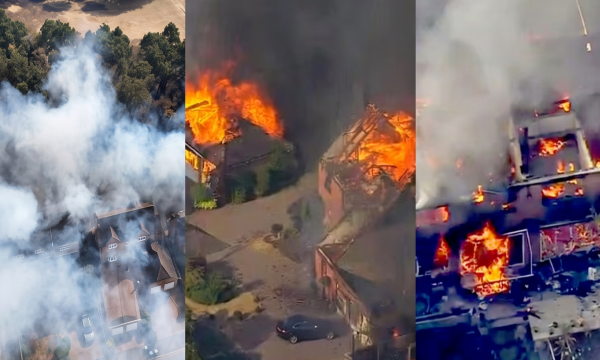
Wildfires swept across parts of the UK on Thursday as extreme heat and strong winds turned fields and grassland into tinderboxes, sending flames towards homes and forcing residents to flee.
Temperatures reached a provisional 38.1 °C (100.5F) at Kew Gardens in west London, making it the hottest day of the year so far and one of the hottest days ever recorded in the country. As temperatures climbed, firefighters faced a wave of emergencies across England and Wales.
In several areas, residents watched helplessly as fires raced through dry vegetation and spread towards family homes. Thick smoke filled the skies, roads were closed, and emergency crews were pushed to what officials described as extreme levels of demand.
Stourbridge Wildfire Destroys Six Homes
One of the most serious incidents occurred near Stourbridge in the West Midlands, where a rapidly spreading wildfire destroyed six houses.
A major incident was declared as around 100 firefighters battled the blaze, which began near Stourbridge Golf Club around midday and burned through approximately 40 acres of land.
Residents described terrifying scenes as flames moved rapidly from gardens and fields towards homes.
One resident said ash had been falling onto roads for hours, while another described the smoke as extremely strong.
Witnesses said powerful winds helped push the fire through dry vegetation. Hedges, fences, and power lines were reportedly caught in the flames, while a fire engine was also engulfed as crews attempted to tackle the blaze.
Several residents were evacuated, with some reportedly told to dampen the outside of their properties before leaving.
A child and three firefighters were taken to the hospital following the incident.
Flames Spread From House to House
Residents in the affected communities described the speed at which the wildfire developed.
Chris Dunnington said black smoke moved across homes from nearby fields before flames reached driveways and fences.
He described the combination of strong winds and dry conditions as a disastrous mix that allowed the fire to intensify rapidly.
Another resident, Jane Baxter, said flames could be seen rising above rooftops.
The intensity of the fire left residents with little time to react. Some grabbed essential belongings before escaping, while others attempted to protect nearby properties as emergency crews worked to contain the flames.
Drone footage showed thick smoke hanging over the area as the fire threatened more properties around the edge of the scorched landscape.
Thousands of Emergency Calls
West Midlands Fire Service said it was dealing with an exceptionally high level of demand.
Chief Fire Officer Simon Tuhill said firefighters had received thousands of emergency calls as multiple incidents developed across the region.
The scale of the emergency placed considerable pressure on crews, who were responding to several separate fires while also dealing with the Stourbridge blaze.
Local councilor Andrew Tromans described the scenes in Stourbridge and nearby Norton as a warning about the growing danger posed by extreme weather and wildfires.
Major Fire Hits Salford Priors
Another major incident was declared less than 30 miles away after a large fire broke out around Salford Priors near Stratford-upon-Avon.
Warwickshire Fire and Rescue Service urged people living nearby to keep their doors and windows closed due to heavy smoke.
Several field fires were reported around Bidford-on-Avon and Salford Priors.
Some people were treated for smoke inhalation as emergency crews concentrated on preventing further danger to residents.
Local farmers also helped firefighters by bringing water bowsers to the area, providing additional water supplies as crews battled the flames.
Birmingham Homes Damaged by Fire
Elsewhere, homes in Castle Vale, Birmingham, were badly affected by another fire.
Two bungalows were reportedly gutted, with images showing extensive damage to the properties. Part of the roof appeared to have collapsed.
A woman was also reported to have suffered serious injuries.
The combination of wildfire smoke and other fires created significant disruption around Birmingham. The M6 northbound between Junctions 5 and 6 was temporarily closed after thick smoke spread across the motorway, creating dangerous driving conditions.
Additional fires were reported in Maypole in south Birmingham and Sandyford in Stoke-on-Trent, where several homes were evacuated.
Six Homes Affected in Pershore
Worcestershire also faced multiple fires during the extreme heat.
In Pershore, around half a dozen homes were reportedly affected after a fire spread rapidly through a residential area.
One witness compared the spread to a domino effect, describing how the blaze moved from one property to another.
James Lees said the incident began around what appeared to be a garden before thick black smoke and flames spread towards nearby houses.
Firefighters eventually confronted a scene involving several homes, with flames visible from both the front and rear of properties.
Hereford & Worcester Fire and Rescue Service said around 30 properties had been evacuated, and approximately 200 properties were left without electricity. One person suffered smoke inhalation.
Norfolk Hit by Multiple Fires
Norfolk was also placed under significant pressure after a series of fires broke out across the county.
Norfolk Fire and Rescue Service responded to 16 emergencies on Thursday afternoon alone.
One major incident involved a fire at Mousehold Heath, where nearby roads were closed while emergency crews worked to contain the flames.
The number of incidents highlighted the scale of the challenge facing firefighters during the country’s extreme heat.
South Wales Fire Destroyed Five Homes
The wildfire crisis had already caused serious damage in South Wales.
Five homes were destroyed in Caerphilly on Wednesday after a fire that began in a field spread towards residential properties.
A woman was arrested on suspicion of arson in connection with the incident.
The Caerphilly fire added to concerns about the growing number of grass and field fires being reported during the prolonged period of hot weather.
UK Records Hottest Day of the Year
The wildfires erupted as the UK experienced its hottest day so far this year.
Temperatures reached 38.1 °C at Kew Gardens, provisionally exceeding the 38 °C recorded at Lingwood in Norfolk on June 26.
The temperature also made Thursday the fifth hottest day ever recorded in the UK.
A rare amber extreme heat warning issued by the Met Office covered parts of the Midlands and south-east England until Thursday night.
The combination of extreme heat, dry vegetation, and strong winds created ideal conditions for fires to spread quickly.
Firefighters Face Growing Wildfire Pressure
The latest wave of wildfires has also raised concerns about the UK’s ability to respond to increasingly frequent extreme-weather emergencies.
The Fire Brigades Union warned earlier this week that the country faces a shortage of firefighters.
Union leader Steve Wright said thousands of additional firefighters were needed to reduce the risk to lives and property.
According to figures cited in the warnings, the UK has already experienced more than 1,000 wildfires this year, making it the country’s worst year on record for such incidents.
Extreme Heat Raises Questions About Fire Safety
The latest fires demonstrate how quickly extreme heat can transform dry grassland into a major threat to residential areas.
A fire that begins in an open field can spread rapidly when strong winds carry flames and burning debris towards nearby homes.
For residents living near grassland, woodland, or farmland, the risk can increase dramatically during prolonged heatwaves.
Emergency services have urged people to follow evacuation instructions and avoid putting themselves in danger while attempting to fight fires.
The events across Stourbridge, Salford Priors, Birmingham, Pershore, Norfolk, and other areas show how difficult it can be for fire services to manage multiple emergencies simultaneously.
A Country Under Pressure From Wildfires
Thursday’s fires created scenes that many residents described as frightening and unprecedented.
Homes were destroyed, families were evacuated, roads were closed, and firefighters were taken to the hospital while emergency crews worked across several regions.
The UK’s record-breaking heat has once again highlighted the growing challenge posed by extreme weather.
With more than 1,000 wildfires already reported this year, the pressure on fire services and local communities is becoming increasingly difficult to ignore.
For the residents forced from their homes, the priority now is safety and recovery. For firefighters, the challenge is to bring the remaining fires under control while protecting communities from further destruction.
As the UK moves beyond its hottest day of the year, the latest wildfire crisis is likely to intensify discussions about emergency preparedness, firefighter numbers, and how communities can better protect themselves from increasingly severe heat and wildfire events.