

A devastating accident inside an under-construction tunnel in Uttarakhand’s Chamoli district has left at least seven workers dead, while three others remain trapped inside. The incident occurred on Thursday evening when a powerful flow of water suddenly entered the tunnel, followed by a major collapse that turned the construction site into a dangerous zone.
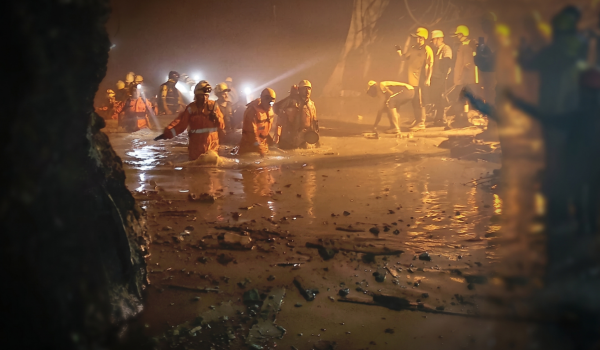
According to officials, 28 workers were present inside the tunnel during the shift. The sudden combination of flooding, mud, and falling debris left several workers struggling to escape. Rescue teams worked through the night in difficult conditions, eventually managing to bring 18 workers out alive.
However, the rescue operation is still continuing because three workers are believed to remain trapped inside the tunnel.
Sudden Water Flow and Tunnel Collapse Trigger Panic
The accident reportedly happened at around 6:30 p.m. on Thursday while workers were carrying out construction activities inside the tunnel.
Without warning, a major section of the tunnel collapsed. Shortly afterward, a powerful stream of water rushed into the underground structure. The sudden movement of water created panic among the workers and made it extremely difficult for them to reach safety.
The force of the water was reportedly strong enough to sweep some workers away. Others became trapped behind piles of mud, rocks, and debris created by the collapse.
Chamoli police officials said the intensity of the water flow made it difficult for workers to maintain their balance or move toward safer sections of the tunnel.
The combination of flooding and structural damage also created serious challenges for rescuers trying to enter the affected area.
Seven Workers Confirmed Dead
As rescue teams searched through the damaged sections of the tunnel, the scale of the tragedy gradually became clearer.
Officials eventually confirmed the deaths of seven workers. Rescue personnel recovered their bodies from inside the tunnel as the search operation continued.
The loss has created a painful situation for the workers’ families, who have been waiting for information about their loved ones since the accident.
At the same time, the successful rescue of 18 workers has provided some relief to authorities and families. The rescued workers received initial medical assistance after their evacuation.
But the situation remains critical because three workers are still believed to be trapped underground.
Rescue Teams Race Against Time
The National Disaster Response Force (NDRF), State Disaster Response Force (SDRF), police, and local administration have joined forces to locate and rescue the remaining workers.
The rescue operation involves removing large quantities of mud, rocks, and other debris while dealing with water inside the tunnel. Every movement has to be carefully planned because unstable sections could collapse again.
For rescue personnel, speed is important, but safety is equally critical.
A tunnel damaged by flooding and a collapse can change rapidly. A seemingly stable section can become dangerous without warning. Rescue workers, therefore, have to assess the structure’s condition before moving deeper inside.
Teams are also attempting to identify the exact locations of the trapped workers and determine the safest possible route to reach them.
Water Makes the Rescue Operation More Difficult
The sudden influx of water has become one of the biggest challenges facing the rescue teams.
In a mountainous region, a large volume of underground or surface water can enter a construction tunnel very quickly. When flooding occurs simultaneously with a collapse, workers may lose their usual escape routes.
That appears to have happened in Chamoli.
Water mixed with mud and debris has reportedly created hazardous conditions inside multiple sections of the tunnel. The rescue teams must therefore work carefully while attempting to control the water and clear blocked passages.
The presence of unstable rocks and debris adds another layer of danger.
A new collapse during rescue work could put both trapped workers and rescuers at further risk.
Uttarakhand Chief Minister Orders Faster Rescue
Following the accident, Uttarakhand Chief Minister Pushkar Singh Dhami directed officials to expedite the rescue operation and take all necessary measures to save the workers still trapped underground.
The state administration has been monitoring the situation closely and coordinating with disaster response agencies involved in the operation.
Officials have emphasized that rescuing the remaining workers is the immediate priority.
The successful evacuation of 18 workers has offered a degree of hope, but authorities remain focused on locating the three people who have not yet been brought out.
Families Wait for News
While rescue workers continue their dangerous operation underground, the families of the trapped workers are facing an agonizing wait.
For them, every update from the rescue site carries enormous importance.
The news of seven deaths has brought grief, while the rescue of 18 workers has offered some hope. The families of the three trapped workers, however, continue to wait for the one piece of news they desperately want: that their loved ones have been found alive.
A tunnel rescue is not simply about removing a worker from a dangerous location. Behind every worker is a family, children, parents, and relatives waiting for them to return home safely.
Why Tunnel Construction Is Risky in Mountainous Areas
Uttarakhand is home to major infrastructure projects, including roads, tunnels, and hydropower developments. Such projects are important for connectivity and economic development, but construction in mountainous terrain comes with significant natural risks.
Landslides, sudden water movement, unstable rock formations, and underground water can create serious problems during tunnel construction.
The geological conditions beneath a mountain can also be difficult to predict. A section that appears stable from the outside may contain weak layers of rock or soil underneath.
For this reason, geological surveys, structural monitoring, and emergency planning are essential when constructing tunnels in mountainous regions.
Questions About Worker Safety
The Chamoli tunnel accident is also expected to raise questions about safety arrangements at the construction site.
Authorities will need to examine several issues, including whether workers had adequate emergency escape routes, whether systems were in place to detect sudden water movement, and whether communication within the tunnel was sufficient.
The availability of emergency equipment and evacuation plans will also be important areas of investigation.
Construction companies working in high-risk environments have a responsibility to provide workers with appropriate safety measures, training, and emergency procedures.
Regular inspections are especially important in tunnels because conditions can change as excavation progresses.
Investigation Needed to Determine Cause
The exact cause of the collapse and sudden flooding has not yet been fully established.
A detailed investigation will be necessary to determine where the water came from, why the collapse occurred, and whether any safety systems could have reduced the impact of the incident.
Investigators may also examine the geological conditions around the tunnel and the construction methods being used at the time of the accident.
If the investigation identifies safety gaps or negligence, corrective action could help prevent similar incidents at other tunnel and infrastructure projects.
Rescue Effort Remains the Top Priority
For now, the focus remains firmly on the three workers still trapped inside the tunnel.
Rescue teams are working through debris, mud, and water while carefully monitoring the structure’s stability. Their challenge is to reach the workers as quickly as possible without putting additional lives at risk.
Time remains critical in any underground rescue operation. Conditions involving oxygen levels, water, temperature, and structural stability can become increasingly difficult as an operation continues.
That is why rescue teams must balance urgency with caution.
A Tragedy That Highlights the Need for Stronger Safety Measures
The Chamoli tunnel accident has already claimed seven lives and left several families devastated. Although 18 workers have been rescued alive, the operation remains unfinished as three workers continue to be trapped underground.
The incident highlights the dangers faced by workers involved in major infrastructure projects in mountainous regions.
Tunnel construction requires careful geological assessment, continuous safety monitoring, emergency escape arrangements, and proper worker training. These measures are not optional extras; they can become the difference between life and death when an unexpected disaster strikes.
As rescue teams continue their efforts in Chamoli, the attention of the workers’ families and authorities remains fixed on the under-construction tunnel.
The immediate hope is that the remaining three workers will be located and brought out safely. At the same time, the tragedy is likely to renew calls for stronger safety standards and better disaster preparedness at tunnel construction sites across India’s mountainous regions.