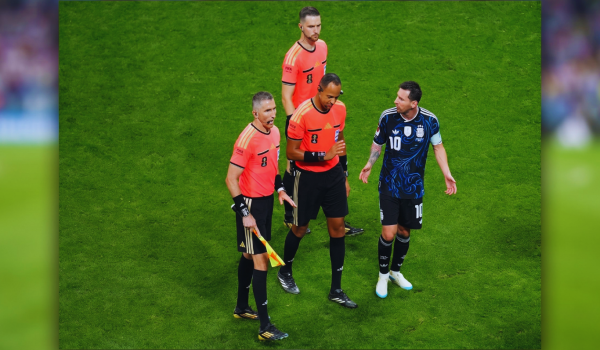


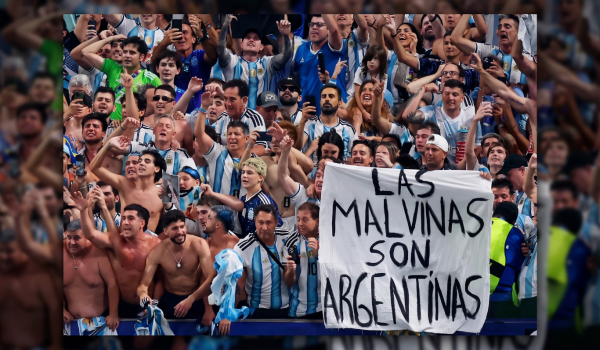
The intersection of sports and politics has once again drawn international attention, this time involving Argentina’s national football team and the long-standing dispute over the Falkland Islands. Following Argentina’s victory over England in a World Cup semifinal, celebrations on the pitch turned into a diplomatic issue after Argentine players and supporters displayed messages related to the sovereignty of the Falkland Islands, known in Argentina as the Malvinas.
The incident has triggered criticism from British officials, with some calling for FIFA to investigate whether the political display may have violated regulations governing political messaging in international football competitions.
Argentina’s World Cup Victory Overshadowed by Political Controversy
Argentina secured a hard-fought victory against England in a highly competitive World Cup semifinal, advancing to the next stage of the tournament. However, much of the post-match discussion shifted away from football and toward politics.
In the aftermath of the match, tensions reportedly flared between players from both teams, leading to heated exchanges on the field. Amid the celebrations, several Argentine players were reportedly seen carrying a banner bearing the phrase “Las Malvinas son Argentinas,” which translates to “The Malvinas are Argentine.”
The slogan refers to Argentina’s claim over the Falkland Islands, a British Overseas Territory located in the South Atlantic Ocean. The message immediately attracted attention, reigniting debate over one of the world’s most enduring territorial disputes.
The Falkland Islands Dispute Explained
The Falkland Islands, located approximately 500 to 600 kilometers off the coast of Argentina, have been under British administration since 1833. Although geographically closer to Argentina, the islands have remained a self-governing British Overseas Territory for nearly two centuries.
Argentina has consistently maintained that the islands are part of its national territory and refers to them as the Malvinas. The sovereignty dispute has been a central issue in Argentine foreign policy for decades.
The disagreement reached its most dramatic point in 1982, when Argentina’s military government, led by General Leopoldo Galtieri, launched an invasion of the islands.
The conflict lasted several weeks and resulted in significant casualties on both sides before British forces regained control of the islands. Since then, the sovereignty issue has remained unresolved, with both nations maintaining their respective positions.
Falkland Islanders’ Referendum and Self-Determination
A key element of Britain’s argument centers on the principle of self-determination. In a referendum held by Falkland Islanders, an overwhelming majority reportedly voted to remain a British Overseas Territory.
British officials frequently cite the referendum as evidence that the islanders wish to remain under British governance. Argentina, however, continues to challenge Britain’s sovereignty over the territory and argues that historical and geographical factors support its claim.
The issue remains highly sensitive in both countries and often resurfaces during diplomatic discussions, international forums, and major sporting events.
Political Messages in Football: A Growing Concern
The controversy surrounding Argentina’s banner has renewed debate about the role of politics in sports.
FIFA has long maintained regulations designed to prevent political, religious, or ideological messages from being displayed during official competitions. The governing body says it aims to ensure that football remains a platform for sporting competition rather than political advocacy.
Critics argue that displaying messages connected to territorial disputes can increase tensions and distract from the spirit of international sportsmanship. Supporters of the Argentine position, however, view such expressions as reflections of national identity and historical memory.
The incident highlights the difficult challenge facing sports organizations as geopolitical issues continue to intersect with major global sporting events.
British Officials Demand FIFA Review
The display of the Malvinas banner prompted criticism from several British figures. Among the most vocal was Trade Secretary Peter Kyle, who reportedly described the behavior as inappropriate and urged FIFA to examine the matter carefully.
British officials and commentators have argued that political statements should not have a place on the football field, particularly during one of the sport’s most prestigious tournaments.
Calls for an investigation have grown as observers question whether FIFA’s existing rules were breached. The governing body now faces pressure to determine whether the display constituted a political act subject to disciplinary action.
Could FIFA Take Disciplinary Action?
Questions are now being raised about potential consequences for the Argentine team or individuals involved in the banner display.
FIFA has previously taken action against players and teams for political demonstrations during official competitions. One frequently cited example involves South Korean footballer Park Jong-woo, who faced disciplinary measures after displaying a politically charged message following a match at the London Olympics.
Because of such precedents, analysts are debating whether Argentina’s actions could result in sanctions. Possible outcomes could range from warnings and fines to disciplinary proceedings against individuals deemed responsible for the display.
However, any decision would depend on FIFA’s interpretation of the incident, the specific circumstances involved, and the evidence collected during any investigation.
Sports, National Identity, and Global Attention
International football often serves as more than just a sporting contest. National teams represent their countries on a global stage, and matches can sometimes become symbolic expressions of historical, political, or cultural issues.
For Argentina, the Malvinas remain a deeply important national topic that transcends politics. For Britain, the wishes of Falkland Islanders and the principle of self-determination remain central to its position.
When such sensitive issues emerge during globally televised events like the World Cup, they attract significant media attention and can quickly become international controversies.
What Happens Next?
As debate continues, football fans, political analysts, and international observers are waiting to see whether FIFA will launch a formal review of the incident.
The governing body has not always responded uniformly to political displays, making it difficult to predict the outcome. Nevertheless, the controversy has once again highlighted the challenges of keeping politics separate from sport in an increasingly interconnected world.
Whether disciplinary measures follow or not, the episode has ensured that discussions about the Falkland Islands dispute have returned to the global spotlight. What began as a celebrated World Cup victory for Argentina has evolved into a broader conversation about political expression, international relations, and athletes’ responsibilities on the world stage.
As FIFA evaluates the situation, the incident serves as another reminder that football’s influence extends far beyond the pitch, often touching some of the most sensitive political issues in international affairs.